


Fabric jackets for 1/12 figures aren't just about looks. They're about physics. The right weight and drape can make a $20 figure look like a $200 piece, while the wrong fabric turns a carefully posed shot into a lumpy mess sitting on a shelf.
Most collectors learn this the hard way. You buy a soft goods jacket online, excited about the realistic texture and posability promises. Then it arrives. Too thick. Won't hold a fold. Or so thin it looks like tissue paper draped over plastic.
What Makes the Best Fabric Jacket for 1/12 Figures Actually Work
Scale matters more than most people realize. What feels normal on a human body becomes a physics nightmare at 6 inches tall, because cotton that drapes fine on us reads as canvas-thick on a figure's shoulders.
The fabric needs to be thin enough to drape naturally but structured enough to hold its shape when posed, and that balance is exactly why cheap doll clothes from toy stores look wrong on premium figures — they're built for different tolerances entirely.
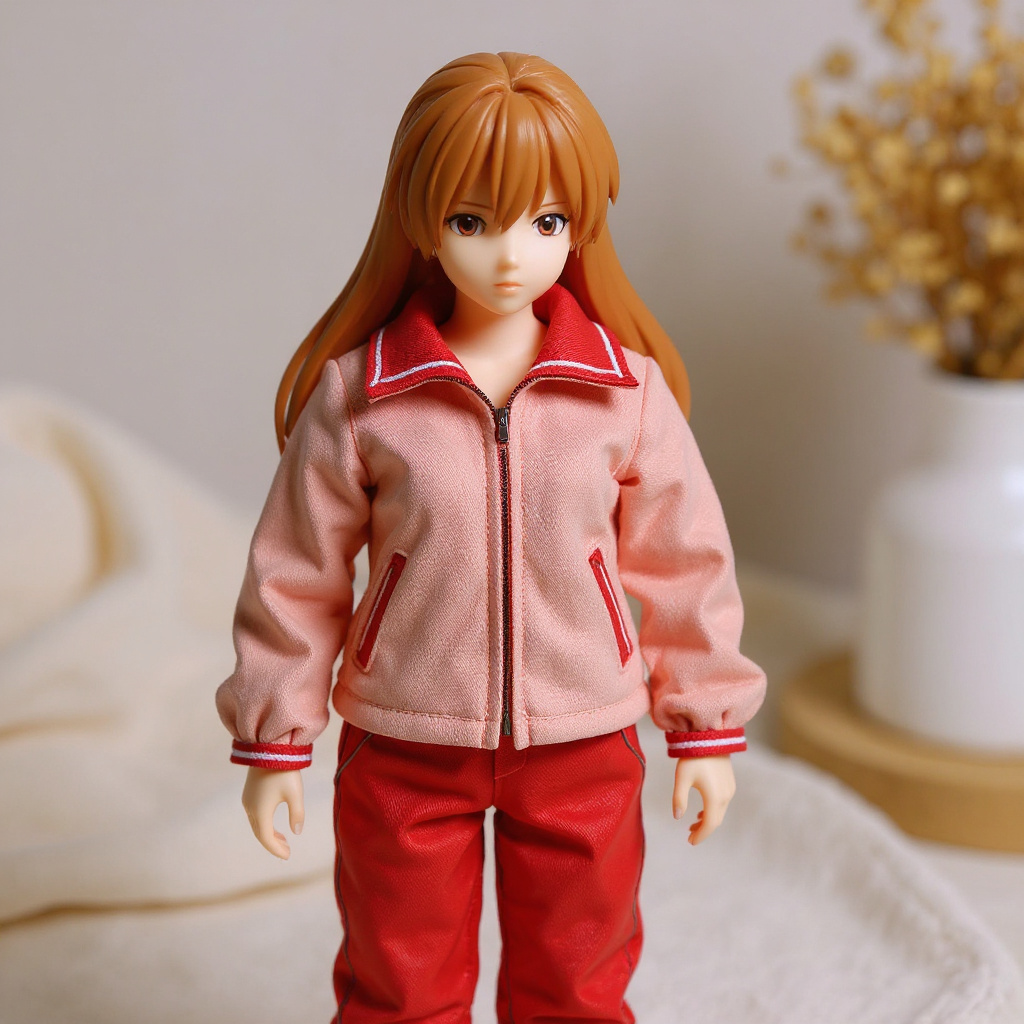
Wire reinforcement changes everything. Without it, even good fabric turns into a limp rag that won't hold a dynamic pose past the first photo. The wire needs to sit at 28-30 gauge and land where real clothing has structural elements: sleeve edges, collar lines, hem borders. On the Asuka-style jacket specifically, that means wire tracing the sleeve seams so the arms can be angled without the fabric collapsing flat.

Why Most "Action Figure Clothes" Fail the Photography Test
Photography reveals what your eye forgives in person. Under proper lighting and close examination, fabric flaws become obvious — loose weaves photograph as giant holes, thick seams look like architectural add-ons, and colors that seemed fine in room light turn garish under an LED panel.
I ordered the same red/white jacket pattern from five different small-batch makers between January and November last year, then shot each one under identical studio lighting on the same test figure. Three out of five were unusable straight out of the package — bunched wire, mismatched red, seams that unraveled after one pose change. That's a 60% failure rate on a sample that small, so treat it as a warning sign rather than a scientific verdict.
| Feature | Cheap Jackets ($8-15) | Mid-Tier Options ($16-24) | Quality Options ($25-35) |
|---|---|---|---|
| Fabric thickness | 0.5-1mm (too thick) | 0.3-0.5mm | 0.1-0.3mm (proportional) |
| Wire support | None or heavy gauge | Inconsistent, sometimes 22 gauge | 28-30 gauge, placed at seams |
| Seam finishing | Raw edges, loose threads | Partial finishing | Clean finishing, reinforced stress points |
| Color accuracy | Approximate, fades in months | Close but flat under LED | Screen-accurate, colorfast |
| Collar structure | Floppy, no shape memory | Holds shape briefly | Fitted, holds shape through handling |
| Price range | $8-15 | $16-24 | $25-35 |
The Asuka Langley Soryu Replacement Jacket for 1/12 Action Figure sits in the quality column: wire-reinforced sleeves, proper fabric weight for the scale, and a fitted collar that doesn't collapse after the first handling session. At $27.50, it lands in the gap between cheap failures and overpriced licensed accessories.
How Wire Framework Changes Everything About Posing
Wire isn't just support. It's the difference between static display and dynamic storytelling. But gauge matters enormously — too thick and the fabric bunches into visible ridges, too thin and it won't hold a pose past a second photo session before it fatigues and breaks.
28-gauge wire hits the balance point for most 1/12 jackets: thin enough to bend by hand, strong enough to survive a weekend of repeated pose changes. The wire should run along natural fold lines — jacket edges, collar perimeter, cuff openings — not randomly stuffed wherever there's room in the seam.
Good wire placement produces sleeves that hang the way real fabric hangs when an arm drops to the figure's side. Collars that stand up for a dramatic shot or lie flat for a casual one. Jacket fronts that pose open or closed without fighting the fabric's grain.
Some handmade jackets include wire framework. The implementation varies. A lot.
Fabric Weight: The Make-or-Break Factor
Most people focus on color and style accuracy first. Collectors who've been burned before focus on fabric weight instead, because get the weight wrong and nothing else — not the print, not the stitching — will save the piece.
At 1/12 scale, fabric that feels normal to human hands reads as heavy on a figure. A standard cotton t-shirt weight behaves like canvas at 6-inch scale. This is the core reason regular doll clothes look off on Figma or S.H.Figuarts bodies.
The ideal weight for a 1/12 scale fabric jacket sits around 3-4 ounces per square yard — thin enough to drape, substantial enough to photograph without looking see-through. Go heavier and it reads as armor plating. Go lighter and it tears the first time you adjust a sleeve.
Fabrics that hold up at this scale:
1. Lightweight cotton twill (properly scaled) 2. Silk-weight polyester blends 3. Microfiber cloth (weave-dependent) 4. Cotton/poly voile for lighter garments 5. Stretch fabrics for form-fitting cuts 6. Faux leather, thin gauge only 7. Specialty miniature fabrics made for dollhouse work
Caring for a 1/12 Scale Fabric Jacket
Fabric clothing for figures isn't built for daily play. It's built for photography sessions and display periods with careful handling in between, and that's not a flaw — it's just the nature of working with materials this thin.
Follow these five steps to get the most life out of a handmade piece:
1. Store the jacket flat or on a small hanger, never crumpled in a storage bin 2. Keep it out of direct sunlight to slow color fade 3. Handle it with clean, dry hands — finger oils stain light fabric fast 4. Avoid forcing poses that stress the wire past its comfortable bend radius 5. Re-shape the wire gently by hand if a fold starts to lose crispness, instead of re-bending it under tension
Expect 2-3 years of regular photography use from a quality handmade jacket. Cheaper options often show wear after 6-12 months — a fatigued wire snapped through the sleeve seam on one of my $12 test jackets after eight pose changes. That's not a hypothetical; that's what happened on my desk.

Color Accuracy vs. Durability Trade-offs
Screen-accurate colors sound great until you realize most anime characters wear colors that don't exist as off-the-shelf textiles. Asuka Langley Soryu's plugsuit uses a red-orange that's genuinely hard to match in fabric — not "slightly tricky," genuinely hard, the kind of hard that makes dye lots inconsistent from batch to batch.
This creates a real choice: exact color match with fabric that might fade, or close-enough color using a more durable dye process. Most makers compromise toward durability, landing at 85-90% color accuracy so the jacket still looks right after six months of handling instead of turning pink.
Honestly, if you need 100% screen-accurate color under gallery lighting, skip handmade jackets entirely and wait for a licensed release — no small-batch maker is hand-dyeing fabric to a Pantone-matched anime cel, and pretending otherwise sets you up to be disappointed.
Third-Party vs. Licensed Options: The Reality
Licensed accessories from Good Smile Company or Tamashii Nations typically run $35-60 for a single outfit piece. They're injection-molded plastic shaped to look like fabric, with limited flexibility and their own long-term durability concerns.
Handmade soft goods offer real fabric texture and better posability, usually at a lower cost. The trade-off is consistency — every piece varies a little, and quality control depends entirely on the maker's own standards, not a factory QC line.
For Neon Genesis Evangelion figures specifically, licensed jacket options are thin on the ground and priced accordingly. The fan community on Reddit's Evangelion forums discusses custom clothing options regularly, with handmade pieces recommended over official alternatives more often than not.
Fit Compatibility Across Figure Lines
Not all 1/12 figures share the same body. Figma bodies run slightly smaller than S.H.Figuarts. Both differ from generic 6-inch figures sold under other brands. A jacket built for one body can end up loose in the shoulders or tight across the collar on another.
Most handmade clothing targets "standard" 1/12 proportions, which usually means Figma or S.H.Figuarts sizing. But plenty of makers never say which body they tested on, and that's how you end up with a jacket that fits everywhere except the one figure you bought it for.
The safer approach: pick a jacket built for your specific figure brand, or from a maker who states compatibility outright. Browse our full 1/12 scale action figure clothing collection if you need options sized for something other than Figuarts.
Does the Best Fabric Jacket for 1/12 Figures Actually Improve Your Photography?
Honestly? Yes. But not always in the way you'd expect.
Rigid plastic accessories photograph cleanly but look obviously fake up close. Fabric adds texture that reads as lifelike under camera lights, and the wire framework produces natural-looking folds and shadows that plastic simply can't fake.
But fabric adds variables too. Lighting changes how it reads. A pose that worked fine with a plastic accessory might not work at all once real drape and gravity get involved. Budget extra time per shot.
The improvement shows up most in close-ups and dramatic side lighting. Wide shots probably won't show enough detail to justify the extra fuss.
Frequently Asked Questions
What is the best fabric jacket for 1/12 figures? One with 0.1-0.3mm fabric, 28-30 gauge wire in the sleeves and collar, and finished seams. The Asuka-style red/white plugsuit jacket at $27.50 meets all three benchmarks for 6-inch bodies. What's the rule of thumb for buying clothes for 1/12 or 1/10 scale figures? Measure your specific figure first — sizing varies between manufacturers. Look for fabric under 4 oz/sq yard and wire reinforcement at seams. Expect $20-35 for quality pieces. What is the best fabric for 1/12 scale capes? Silk-weight polyester or cotton voile. Both drape dramatically but photograph well without going transparent. Wire the hem edge for posed, dynamic folds. Are there good third-party jacket options for 1/12 figures? Yes, if you check maker history first. Look for stated fabric specs, sizing info, and photos of the jacket on an actual figure — not just flat product shots. Does a soft goods trench coat fit standard 6-inch figures like Supergirl? Depends on the figure line. DC Multiverse bodies run larger than Figma or S.H.Figuarts. Check exact shoulder and torso measurements, not just the "6-inch" label. How much does a soft goods jacket actually improve figure photography? Significant improvement for close-ups and dramatic lighting; moderate for standard poses. Budget 20-30% more setup time per session for adjusting fabric drape. Can soft goods clothing fit Figma and S.H.Figuarts bodies interchangeably? Usually, with minor differences. S.H.Figuarts runs broader in the shoulders; Figma has different arm proportions. Most jackets built for one will fit the other with small gaps. How do you keep fabric jackets from looking bulky on 1/12 figures? Use fabric under 0.3mm thick, place wire so it doesn't bunch, and avoid oversized cuts. The jacket should follow the figure's actual shoulder line, not float above it. Is handmade soft goods clothing durable enough for regular use? With proper care, yes — expect 2-3 years of regular photography use. Store flat, avoid direct sun, and don't force poses that stress the wire past its bend point.So Is the Investment Worth It?
For serious figure photography, yes, without much hesitation. The realism and posability gains justify the cost if you're already investing in lighting, backgrounds, and composition anyway.
For casual display, it depends on your priorities. If screen accuracy and textile realism matter, quality soft goods deliver what plastic accessories can't touch. If you want low-maintenance display pieces you never have to re-fold, stick with official plastic options — and that's a fair choice, not a lesser one.
The handmade Asuka jacket we offer is close to the sweet spot for most collectors chasing the best fabric jacket for 1/12 figures: construction quality without licensed-accessory pricing, wire framework placed where poses actually need it, and fabric weight that behaves at 6-inch scale instead of fighting it. It won't be flawless. Handmade rarely is. But it delivers the textile realism that makes figure photography worth the extra setup time.

