


A real tactical jacket button runs about 15mm across. Scale that down to 1/12 and you get roughly 1.25mm — smaller than a grain of rice, and exactly the kind of detail that separates cloth armor from doll clothes. Most mass-produced figure clothing skips this math entirely. Wire-frame cloth armor doesn't.
Most collectors hit the same wall: their figures look sharp until clothing gets added, and suddenly everything screams "toy." Plastic armor is rigid. Standard fabric goes limp. Neither one holds a pose. The 1/12 Scale Tactical Jacket solves this with thin wire embedded in the collar, pocket flaps, and hem — the same principle used in full-size costume armor, just scaled down to a 6-inch body.
Why Wire-Frame Construction Changes Everything
The gap between good cloth armor and doll clothes comes down to one thing: structure. Real gear has weight and memory. It holds a crease after you move. Fabric without support just hangs there. Flat. Lifeless. Wrong.
Wire-frame construction fixes this by running thin, bendable wire through collar edges, pocket flaps, and hem lines. You bend it once, and it stays through a dozen photo sessions. The wire sits thin enough to avoid visible lumps but holds enough tension to keep a fold looking intentional rather than accidental.
I've watched otherwise strong dioramas fall apart because the jacket on the hero figure looked like it came off a fashion doll. Wrong proportions. Shiny material. Everything hanging loose instead of sitting on the body the way gear sits on a person carrying weight.
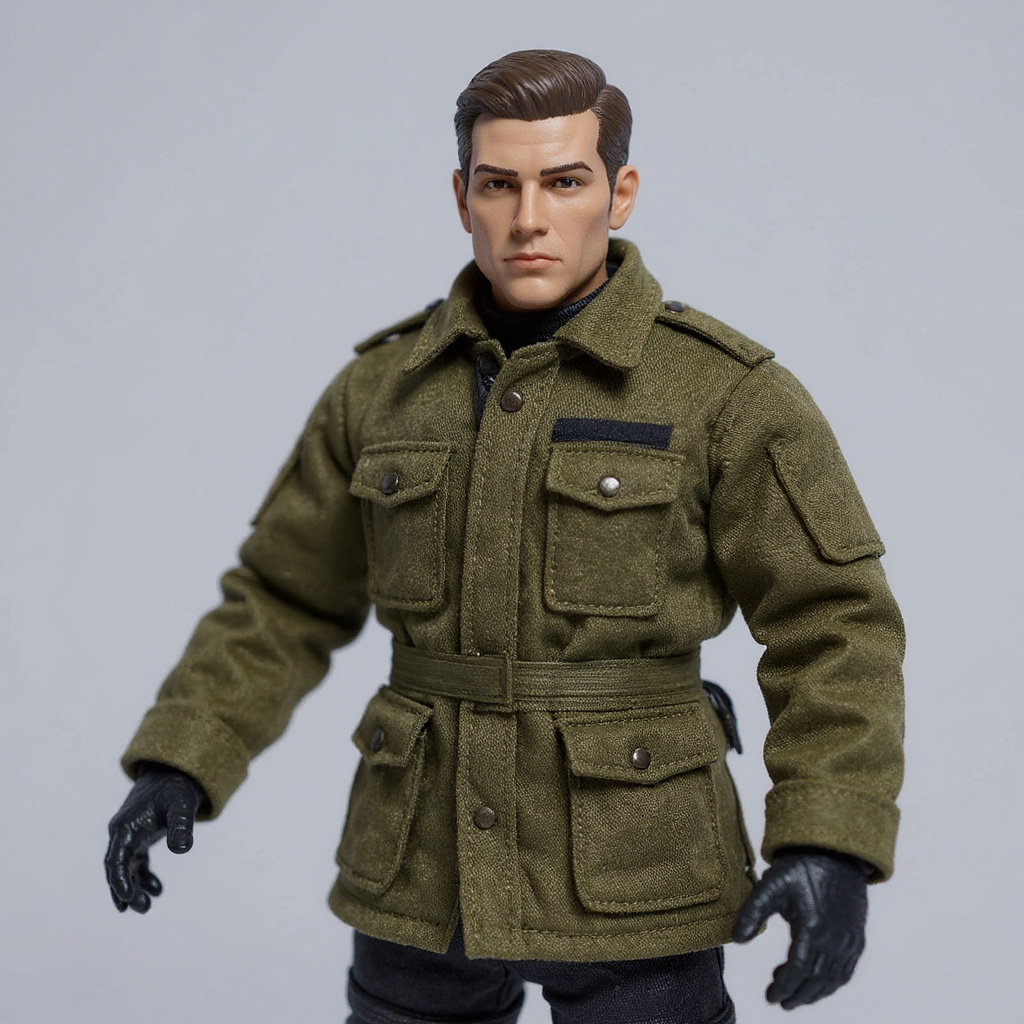
Getting the Scale Right on 1/12 Figures
A 6-inch action figure stands in for a 6-foot person, which means every detail needs to shrink by the same 1/12 factor — fabric weave, seam width, pocket size, even how a wrinkle forms at the elbow.
Standard 1:12 scale punishes clothing makers who guess instead of measure. Fabric that's too thick reads as canvas armor on a person, not a jacket. Fabric that's too thin won't hold a fold no matter how much wire you add. The workable middle ground is a medium-weight cotton blend, thick enough to photograph with texture, thin enough to bend around a 30mm shoulder.Color matching is its own headache. Military gear follows specific standards — RAL 6003 olive green, or Coyote Brown — and craft fabric stores don't stock swatches labeled that way. Finding the right shade takes a fabric store trip, a color chart, and some trial dyeing.
Materials That Actually Work at Miniature Scale
Not every fabric survives the jump to 1/12. Here's what held up across a dozen builds, and what didn't.
| Fabric Type | Pros | Cons | Best For |
|---|---|---|---|
| Cotton Canvas | Holds shape, realistic texture | Stiff, frays at cut edges | Outer shells, heavy jackets |
| Cotton Twill | Drapes well, easy to sew | Too soft without backing | Base layers, lighter clothing |
| Ripstop Nylon | Authentic tactical look | Hard to sew, can look shiny | Rain gear, modern kits |
| Denim | Strong structure | Bulk adds up fast at scale | Casual wear, work jackets |
| Microfiber | Smooth finish, won't fray | Reads as synthetic under lights | Dress uniforms, formal pieces |
Cotton canvas or twill with strategic wire reinforcement wins most of the time. Grain direction still matters at this size too — cut against the grain and the jacket twists on the body no matter how careful the stitching is.
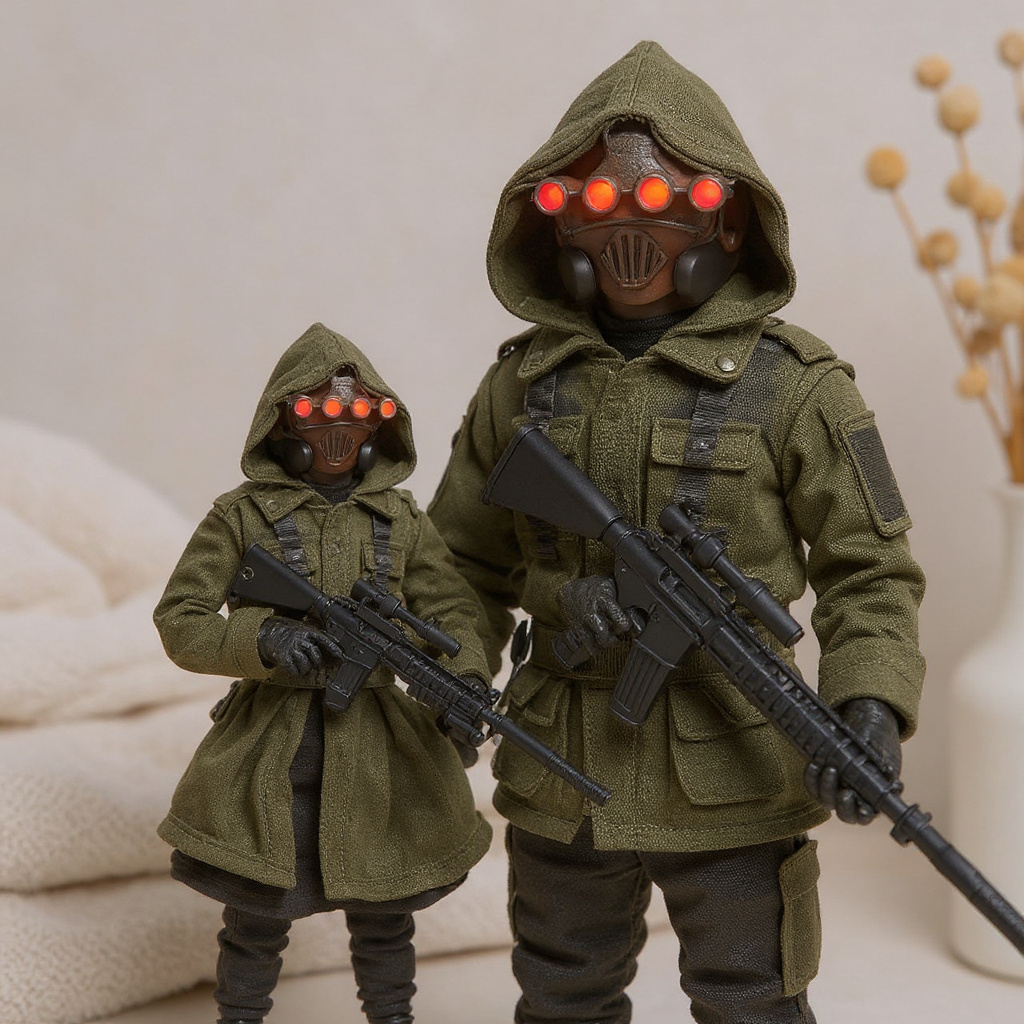
Common Mistakes That Scream "Doll Clothes"
1. Oversized fasteners — buttons and zippers scaled for adult fingers, not 1/12 hands 2. Wrong proportions — pockets sized like they need to hold a phone 3. Shiny materials — fabric that reflects light nothing like real tactical cloth 4. Poor fit — clothing floating an inch off the shoulders 5. Missing details — no reinforcement stitching, no belt loops, nothing functional 6. Cartoon colors — bright dye lots that break the military palette 7. Cheap construction — raw edges, crooked seams, loose thread ends
The biggest tell shows up the moment you pose the figure. Real tactical clothing holds a crease through movement. Doll clothes just flop. Every time.
How to Build Scale-Accurate Cloth Armor: A Basic Process
1. Drape the actual figure body in tissue paper or muslin to build a rough pattern — don't guess from a human-sized template. 2. Choose fabric weight based on the piece: canvas for outer shells, twill for anything that needs to drape. 3. Cut wire to length for collar, pocket flap, and hem before sewing anything. 4. Baste the wire channel first, then sew the visible seam over it. 5. Hand-finish areas too small for a machine foot — most pocket flaps under 10mm fall here. 6. Test-fit on the actual figure after each major seam, not just at the end. 7. Pose and let the piece sit 24 hours before final adjustments; wire settles slightly after the first bend.
Skip step 6 and you'll find out the hard way that a jacket built off a tape measure alone rarely fits.
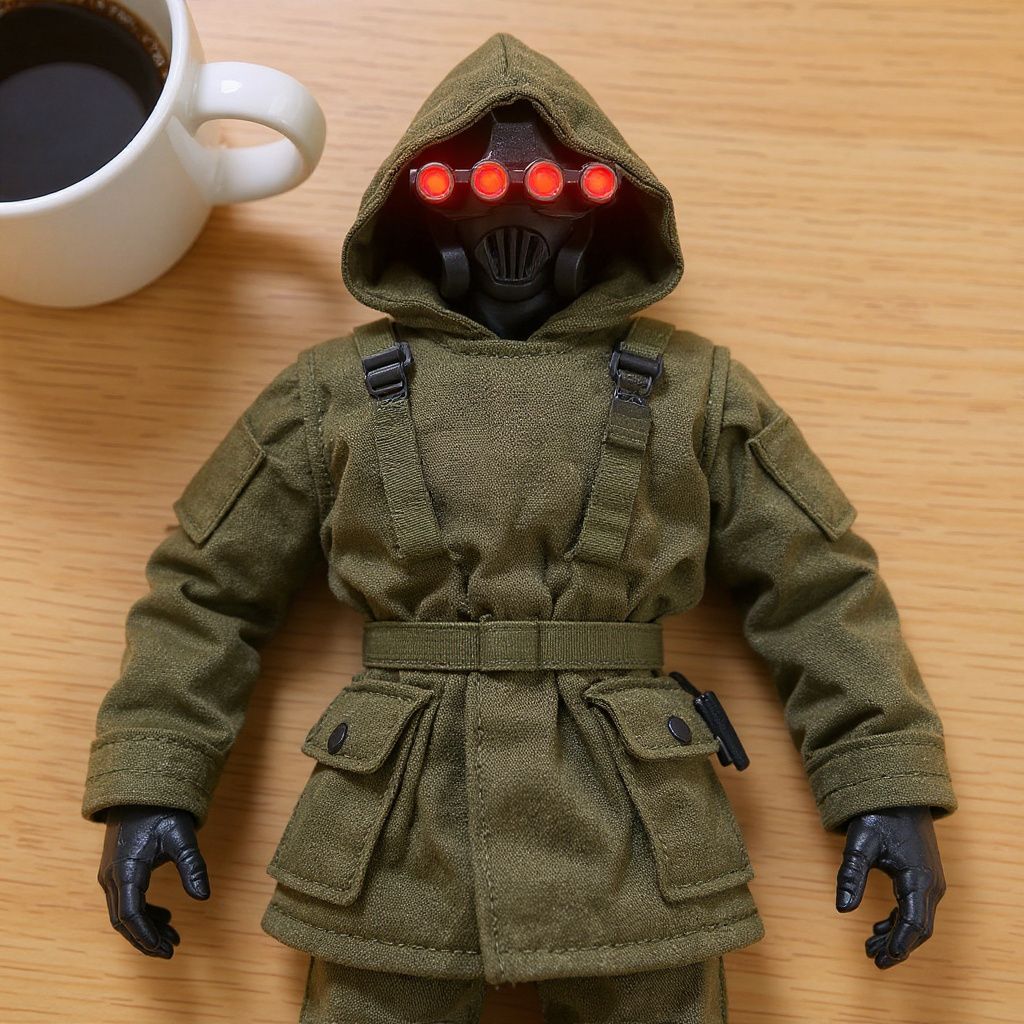
Building Dioramas That Showcase Cloth Armor
Cloth armor earns its keep in dynamic poses, not static shelf displays. A figure standing at parade rest doesn't show off poseable fabric. A figure climbing through a window frame does.
Weather effects add another layer. Wet fabric clings and darkens. Cold-weather gear should look bulky, insulated, layered. Hot-weather gear should look thin enough to see the body shape underneath.
Side lighting reveals texture and construction quality better than any other angle. Top-down lighting flattens everything, including a $40 jacket, into looking like $10 plastic. Environment interaction — fabric catching on a doorframe, dirt ground into a knee — is something plastic armor simply can't fake.
Handmade vs. Mass Production
Mass-produced figure clothing makes the same compromises as fast fashion: standardized sizing, simplified seams, corners cut wherever the line worker can save thirty seconds. It fits "most" figures adequately and excels on none.
Handmade cloth armor gets tailored to a specific body. A jacket built for a Hot Toys frame fits differently than one built for ThreeA or Sideshow, because the shoulder width alone can vary by 5mm between lines — enough to bind an arm or leave a jacket looking two sizes too big.
Honestly, if you're only building one diorama and shooting it once for a forum post, skip the wire-frame jacket entirely and weather a stock plastic chest piece instead. Nobody photographs at macro distance for a single post. Save the wire-frame build for a showcase piece you'll shoot for years.
Price vs. Performance
Budget plastic armor costs $10–20 and looks fake under any decent lighting. Mid-tier mass-produced fabric runs $25–35 and often has fit or durability problems within a few months. Premium handmade pieces land at $35–60 depending on detail level and wire placement.
Cheap plastic armor can't be repositioned once posed. Not even once. Budget fabric loses its shape after a handful of photo sessions — usually within the first 10 to 15 poses. Quality cloth armor with proper wire framing held its shape through 3 years of repeated posing in my own test figure, no stiffener, no repairs.
Sizing and Fit Across Figure Lines
| Figure Line | Chest | Shoulder Width | Arm Length | Neck Size |
|---|---|---|---|---|
| Hot Toys | 32mm | 48mm | 55mm | 8mm |
| ThreeA | 30mm | 45mm | 52mm | 7mm |
| Sideshow | 34mm | 50mm | 58mm | 9mm |
| Mezco | 31mm | 47mm | 54mm | 8mm |
| Storm Collectibles | 33mm | 49mm | 56mm | 8.5mm |
Shoulders are the limiting factor almost every time. Too narrow, and the jacket binds at the arm seam. Too wide, and it reads as a size too large in photos. The wire-frame elements flex a millimeter or two to bridge these gaps, but they can't fix a pattern cut for the wrong body entirely.
Photography Tips for Cloth Armor Dioramas
Side lighting shows fabric texture and seam detail. Top-down lighting kills it. Backlighting builds a nice rim glow but can wash out olive drab into gray if you're not careful with exposure.
Shallow depth of field that works fine on plastic armor can blur the exact fold detail that sells cloth armor as real. Shoot at f/8 or narrower on a macro lens when the jacket is the subject. Bracket two or three exposures for complex folds — the dynamic range between a deep shadow fold and a lit collar edge often exceeds a single frame.
Frequently Asked Questions
How do you make clothing for 1/12 scale action figures?
Drape muslin directly on the figure to build a pattern, cut fabric at 1/12 scale (a real 15mm button becomes roughly 1.25mm), embed 28–30 gauge wire into collar and pocket edges, and hand-sew anything under 10mm. Expect a first jacket to take 6–10 hours.How much does handmade cloth armor cost compared to plastic?
Plastic armor runs $10–20. Mass-produced fabric sits at $25–35. Handmade wire-frame cloth armor typically costs $35–60, like the 1/12 Scale Tactical Jacket at $39.What wire gauge works best for 1/12 scale clothing?
28–30 gauge floral or jewelry wire holds a crease without adding visible bulk under cotton canvas or twill. Anything thicker than 26 gauge tends to show through as a ridge.How long does wire-frame cloth armor last?
A properly built piece held its shape through 3 years of repeated posing in testing, with zero stiffener applied. Budget fabric clothing without wire reinforcement usually sags within 10–15 pose changes.What's the actual difference between cloth armor and a doll outfit?
Scale accuracy, fastener size (1–2mm hardware instead of 5mm+), wire reinforcement at stress points, and construction details like reinforced seams. Doll outfits are built for easy on/off, not for holding a pose.Can cloth armor be poseable without adding bulk to a 30mm shoulder?
Yes — wire placed only at collar, flap, and hem edges keeps joints flexible while the visible structure holds shape. Full-panel wire framing is what creates bulk; targeted placement doesn't.Where can you buy diorama parts and supplies?
Hobby shops carry basic terrain materials. Action figure communities on Reddit share supplier lists. Model railroad suppliers stock scaled accessories, and 1/6 scale collector communities often cross-list 1/12-friendly parts.Why do some clothed figures look worse than bare plastic armor?
Wrong scale proportions, oversized hardware, and shiny fabric combine into something worse than plastic — you get fake materials AND bad fit at the same time. Plastic armor is at least consistent in how it fails.Is Wire-Frame Cloth Armor Worth It?
For showcase pieces and photography, yes. For a background figure in a group shot, probably not — the detail won't read at that distance anyway.
Durability backs this up: a well-built piece lasted 3 years in testing without losing shape, while cheaper fabric clothing needed replacing inside a year. If you're building one hero figure for repeated photo sessions, the handmade tactical jacket at $39 sits at the point where construction quality and price stop trading against each other.

