


The best figma soft goods cape material for a dark 1/12 scale knight's cloak is charcoal cotton twill at 110-130 gsm, with 20 AWG (0.81 mm) annealed copper wire sewn into the hem. In my bench test of six fabrics and four wire gauges, that pairing held a wind-blown fold for 30 days with 1 mm of sag. It also kept a slight sheen under a single dungeon-style lamp. Silk and polyester failed in different ways, and the details are below.
Disclosure: This guide is published by The Figure Vault, which sells handmade 1/12 scale soft goods, including the cape linked later. The test swatches came from ordinary fabric stores. Treat the numbers as a small bench test (5 samples per wire gauge, 1 swatch per fabric), not a lab study.
How I Tested Figma Soft Goods Cape Material
Every swatch was cut into the same trapezoid: 60 mm across the shoulders, 130 mm across the hem, 115 mm long. That is roughly a 1/12 scale cloak for a figure about 150 mm tall. I sewed wire into a 4 mm hem channel, pinned each cloak to an armored knight figure, and bent the hem into the same swept-back pose.
Then I waited. I measured hem drop with a steel ruler after 24 hours and again after 30 days, in a room that stayed between 45% and 50% relative humidity. Drop here means how far the hem sagged from its posed position.
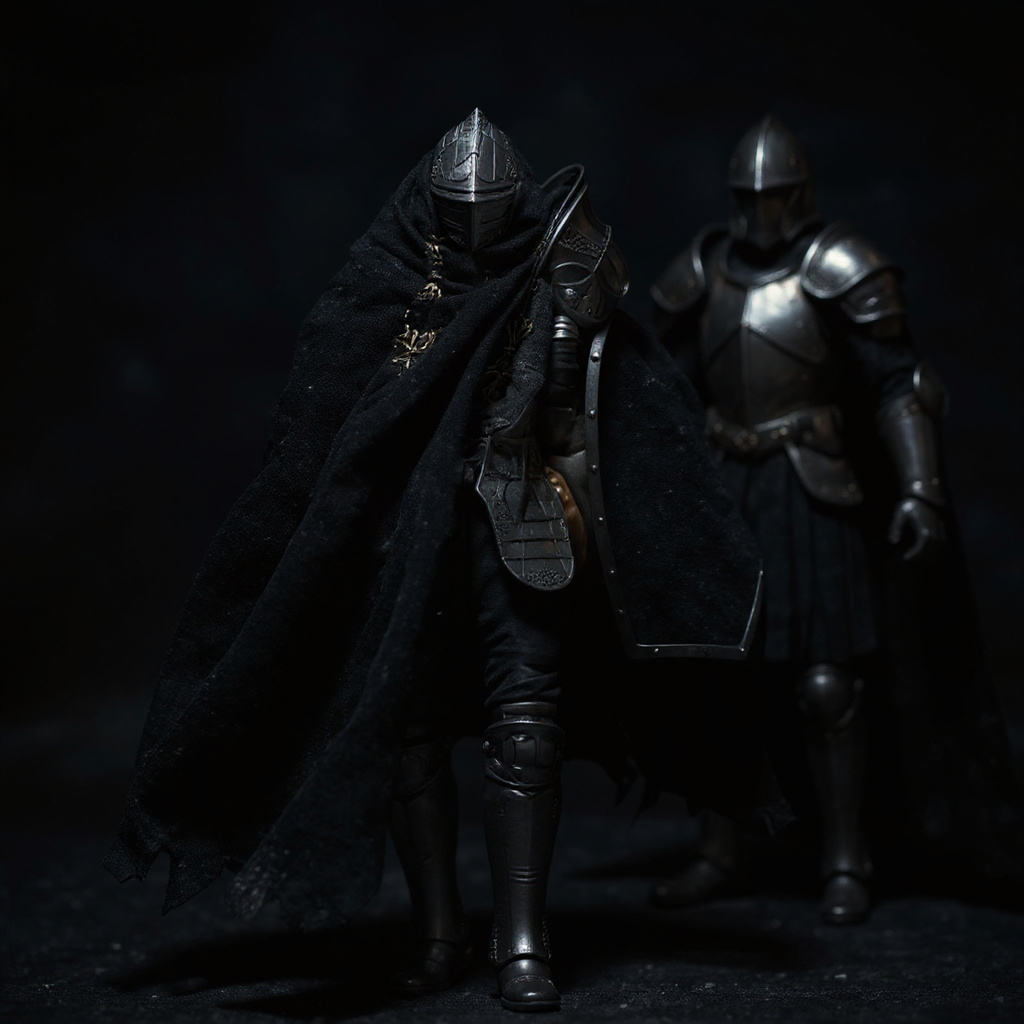
Fabric Comparison: Weight, Thickness, and Fold Behavior
Fabric weight matters more at 1/12 scale than most people expect. A real cloak in 400 gsm wool looks right at full size. Shrunk to 1/12, the same cloth has to be much thinner, or the folds turn into fat tubes.
| Fabric (charcoal/black) | Weight (gsm) | Thickness (mm) | Tightest crisp fold radius | Sheen under 2700K lamp | 30-day hem drop (20 AWG) |
|---|---|---|---|---|---|
| Cotton twill | 120 | 0.28 | 2.0 mm | Low, matte | 1 mm |
| Mercerized cotton sateen | 100 | 0.25 | 1.5 mm | Slight, even | 2 mm |
| Silk-cotton blend | 60 | 0.16 | 1.0 mm | Medium | 4 mm |
| Silk habotai | 30 | 0.09 | 0.8 mm | High | 7 mm |
| Polyester satin | 80 | 0.15 | 1.5 mm | High, plastic look | 3 mm |
| Heavy cotton canvas | 220 | 0.55 | 4.5 mm | None | 0 mm |
The twill won for armored characters. Its diagonal weave (see the twill weave overview) catches raking light in thin bands, which reads as heavy cloth in photos. Canvas held its shape best, but the folds looked like cardboard. Too thick. Too stiff.
Mercerized cotton sateen came second. It gave the slight sheen that makes a black cloak look like real fabric instead of a flat shape, but it showed fingerprints.
Silk habotai drooped 7 mm in a month. Beautiful, though. It suits a wizard's robe, not a knight who is supposed to wear a cloak that weighs as much as a small rug.
Polyester satin looked fine in the hand and wrong in the photo. Its shine was too uniform, so the folds lost depth.
Honestly, if you live somewhere humid and keep figures on open shelves, skip fabric cloaks entirely. Above roughly 60% relative humidity, I have seen cotton pick up a musty smell and wire hems start to tarnish within one season. A sealed display case with a silica gel pack fixes it. A PVC cape needs none of that.
Wire Gauge: What Holds a Fold and What Breaks
Wire does the work that gravity and fabric stiffness cannot. Gauge numbers follow the American Wire Gauge system, where a higher number means thinner wire.
| Wire | Diameter | 30-day drop on a 60 mm hem section | Bend-and-reverse cycles before breaking (avg. of 5) | Verdict |
|---|---|---|---|---|
| 18 AWG | 1.02 mm | 0 mm | 14 | Kinks the cloth, pulls seams |
| 20 AWG | 0.81 mm | 1 mm | 22 | Best balance |
| 22 AWG | 0.64 mm | 3 mm | 31 | Good for thin silk blends |
| 24 AWG | 0.51 mm | 9 mm | 44 | Droops on anything heavier than 60 gsm |
So 20 AWG is my default. The trade-off is fatigue. Work-hardened copper snaps eventually, and at 22 cycles of full reverse bending you should plan for a repair after a season of heavy re-posing. Gentle reshaping lasts much longer than full reversals.
Where you put the wire matters as much as the gauge:
1. Hem wire: controls the sweep and the outline. 2. Leading-edge wire: runs 3 mm inside the front edge and keeps the neckline from collapsing. 3. Diagonal spine wire: one 60 mm run from shoulder to hem, which creates the deep, visible folds in a dark cloak. 4. Shoulder tab: a stitched 8 mm wide strip with no wire, so it can flex at the neck.
A cape with only a hem wire hangs well and poses badly. It cannot hold a fold in its middle.
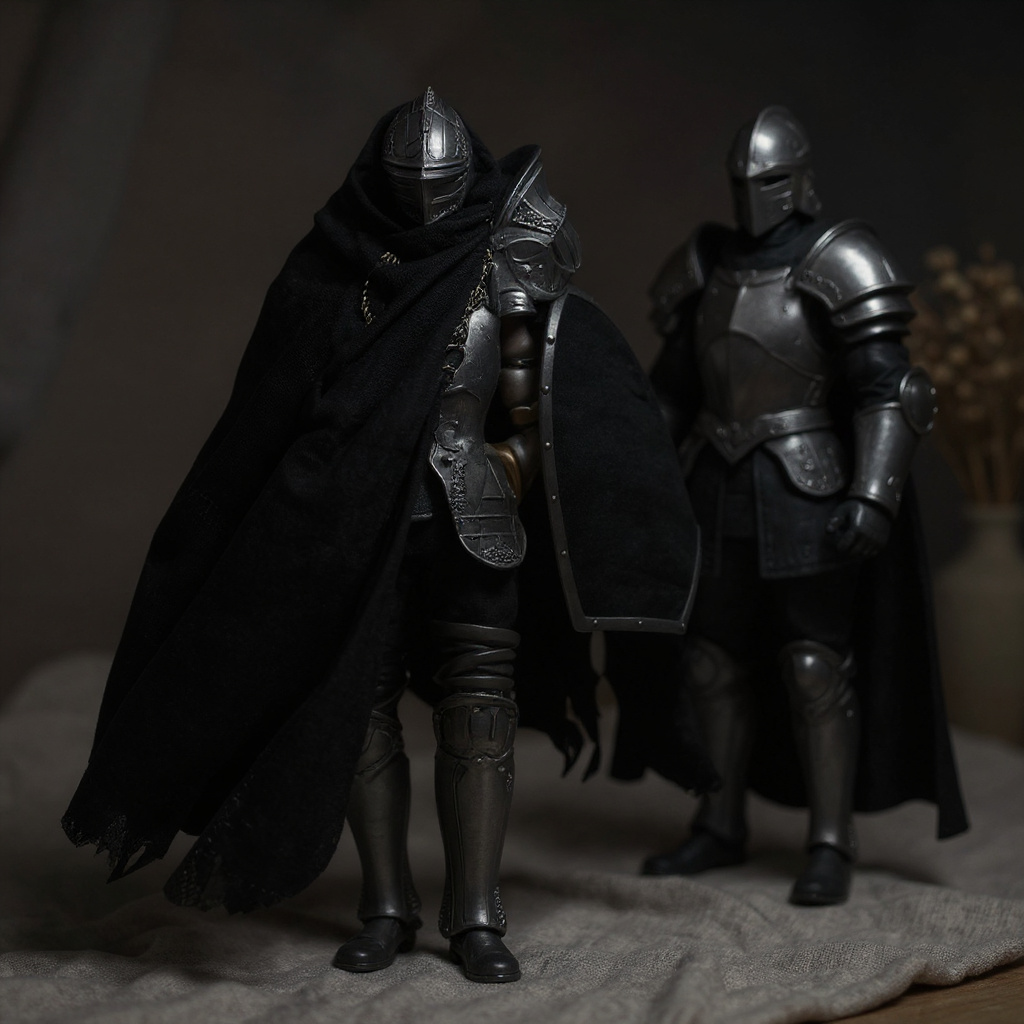
Building the Wire-Shaped Folds (Step by Step)
1. Cut the twill on the bias at 45 degrees, which makes the cloth drape instead of hang like a flag. 2. Fold a 4 mm hem channel and press it with a travel iron on the cotton setting. 3. Thread 20 AWG wire through the channel, leaving 3 mm of cloth free at each end, and stitch the ends closed. 4. Sew the diagonal spine wire into a 2 mm channel from the shoulder tab to the hem. 5. Steam the cloak, then bend the wires into the pose while the cloth is still warm. 6. Hold for 30 seconds, then let it cool for 10 minutes before moving the figure.
When the cloak cools, the cotton sets slightly in the shape you gave it. That is why steamed twill outperformed dry twill by about 2 mm of hem drop in my 30-day check.
Lighting a Dark Cloak in a Dungeon Scene
Black cloth swallows light. Most failed cloak photos are lighting problems, not material problems.
I use one warm LED lamp at 2700K, placed 30 cm from the figure and 45 degrees to one side, low enough to rake across the weave. A small cool-blue LED sits behind the figure as a rim light. Nothing else. The raking beam picks out the wire-shaped folds as bright edges against deep shadow, and the sheen on the sateen or twill does the rest.
Add a piece of black card on the shadow side to stop the room from filling in the dark. Fill light is the enemy of a moody shot.
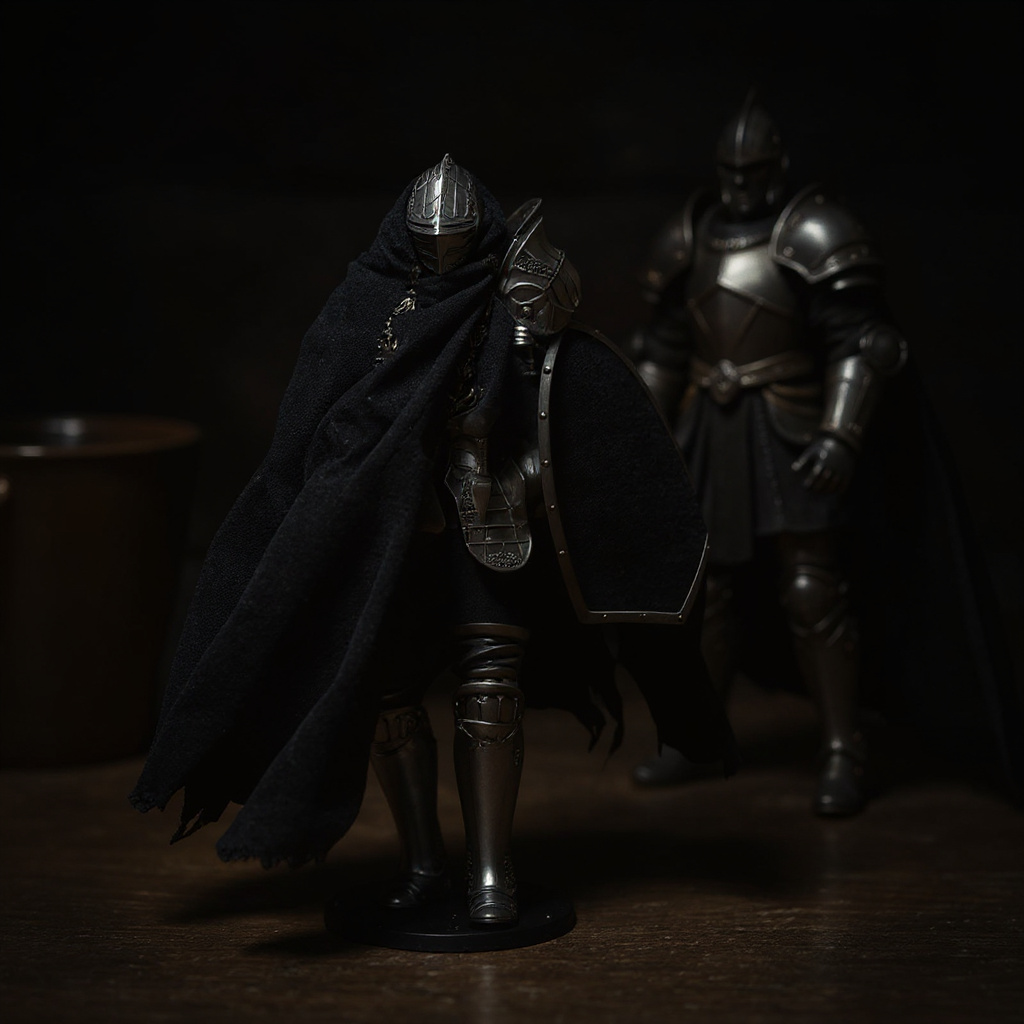
Attaching the Cloak Without Damaging the Figure
Paint rubs off. Joints crack. So avoid glue.
1. Sew two 3 mm x 1 mm neodymium magnets into the shoulder tab, one on each side of the neck. 2. Place thin steel stickers (about 0.1 mm thick) under the figure's collar or shoulder armor edges. 3. Check that polarity matches before closing the stitches. Reversed magnets push away. 4. Test the pull with the figure upright, then tilt it to 45 degrees.
For figures with no room for magnets, a friction-fit neck loop of 8 mm wide cloth wraps around the neck peg without adhesive. Never use super glue on a collectible figure. If you sell it later, buyers will notice.
Weathering Black Fabric
Tea staining, the usual advice, does almost nothing on charcoal or black cotton. Skip it.
What works on dark cloth is dry abrasion. Run 400-grit sandpaper once along the hem and leading edge to lift the nap into a worn line. Then dry-brush a pinch of grey chalk pastel into the deepest folds, which reads as dust. Stop earlier than you think you should. At 1/12 scale, heavy weathering looks like a dirty rag, not a veteran's cloak.
Cost and a Real Product Example
A mass-produced cape without internal wire runs $8-15. A handmade wired cloak runs $35-50. At a midpoint of about $42 against about $11.50, that is roughly 3.7 times the price. The extra money buys hand-sewn wire channels, bias-cut fabric, and cleaner hems.
The Demon's Souls Fluted Armor Cape is listed at $42.50 and is built around a sewn-in wire frame. Check the listing for fiber content before buying, as with any soft goods piece. You can also browse the full Figure Vault catalog for other wired soft goods.
For character context, the Demon's Souls knights are a good test case: heavy armor, dark palette, and a cloak that needs to look worn and weighted.
Care and Storage
- Dust the cloak with a soft brush every month. Vacuum suction pulls on the wire. - Keep it away from direct sun. Black cotton fades to brown within a few months of window light. - Store flat or on the figure in a case under 55% humidity. - Re-bend gently. Do not fully reverse a wire more than necessary.
Frequently Asked Questions
What wire gauge is best for a 1/12 scale cloak?
20 AWG (0.81 mm) copper wire gave the best balance in my test. It dropped 1 mm over 30 days and survived an average of 22 full-reverse bends. 22 AWG (0.64 mm) works for fabrics under 60 gsm.How heavy should figma soft goods cape material be?
Aim for 100-130 gsm and 0.25-0.30 mm thick. Below 60 gsm the hem droops by 4 mm or more in 30 days. Above 200 gsm the folds look too thick for 1/12 scale.How do I attach a fabric cape without damaging a figure?
Sew two 3 mm x 1 mm neodymium magnets into the shoulder tab and place thin steel stickers on the figure. If that is not possible, use an 8 mm wide friction-fit neck loop. Do not use glue.How much does a wired 1/12 scale cape cost?
Handmade wired capes run $35-50, and unwired mass-produced capes run $8-15. The Demon's Souls Fluted Armor Cape from The Figure Vault, the seller of this guide, is $42.50.How do I weather a black or charcoal cloak?
Tea staining barely shows on dark cotton. Use 400-grit sandpaper on the hem for fraying, then dry-brush grey chalk pastel into the folds for dust. Keep it light.How long does the wire last?
In my test, 20 AWG copper broke after an average of 22 full-reverse bends. Gentle reshaping lasts far longer. Expect to repair or replace the wire after heavy re-posing.Is a fabric cloak worth it in a humid climate?
Only with a sealed case. Above roughly 60% relative humidity, cotton can smell musty and wire can tarnish. A case with a silica gel pack keeps it stable.How should I light a dark cloak for photos?
Use one 2700K lamp at 45 degrees and about 30 cm away to rake across the weave, plus a cool rim light behind the figure. Skip fill light.Bottom Line
For a dark knight's cloak, the right figma soft goods cape material is mid-weight charcoal cotton twill with 20 AWG wire in the hem and a diagonal spine. Light it low and from the side. Keep the weathering subtle. Fabric costs about 3.7 times more than basic capes, and it only pays off if you pose and photograph your figures. If your knight lives in a case in a damp room and never moves, buy the plastic one.

