


A 1/12 action figure wardrobe upgrade means replacing molded or factory clothing with sewn fabric cut to 1/12 proportions: a 6-inch (15 cm) figure needs sleeves near 2 inches, fabric under 0.3 mm thick, 28–30 AWG wire in collars and cuffs, and a budget of $25–60 for handmade pieces.
That is the short version. The rest of this guide covers the math, a fit-check routine, a wired-sleeve sewing method, and where a hand-stitched yellow jumpsuit-style outfit fits in.
A note on sources: the measurements below are scale conversions of standard adult dimensions. They are not lab readings from specific figures. Price ranges reflect common marketplace listings and change often, so check current listings before you buy.What a 1/12 Action Figure Wardrobe Upgrade Changes
Plastic clothing is sculpted once and stays that way. Fabric is different. It folds at the elbow, bunches at the waist, and settles under its own weight, so a custom cloth outfit makes the figure look like it is wearing clothes instead of being painted with them.
That is the appeal. It is also the risk. Cloth that is too thick looks like a sleeping bag on a doll.
The upgrade comes down to three choices: scale-correct measurements, thin fabric that drapes, and wire where you want a pose to hold. Get all three right and the figure poses naturally. Miss one and the outfit fights the joints.
1/12 Scale Measurements: Real Body to Figure Size
A 1/12 figure divides every human dimension by 12. A person who is 72 inches (6 feet) tall becomes 6 inches, or about 152 mm. Everything else follows from that one division.
| Body measurement | Typical adult (in) | At 1/12 (in) | At 1/12 (mm) |
|---|---|---|---|
| Height | 72 | 6.00 | 152 |
| Shoulder width | 18 | 1.50 | 38 |
| Chest circumference | 40 | 3.33 | 85 |
| Waist circumference | 32 | 2.67 | 68 |
| Sleeve length (shoulder to wrist) | 25 | 2.08 | 53 |
| Inseam | 32 | 2.67 | 68 |
| Neck circumference | 16 | 1.33 | 34 |
One trap: circumference is not width. A waist of 2.67 inches is the distance around the body. If you flatten a figure and measure straight across, you get about 1 inch. Compare circumference to circumference and width to width. Never mix them.
The same division applies to mistakes. A 1/8-inch (3 mm) error multiplied by 12 equals 1.5 inches at human size. That is the difference between a sleeve that reaches the wrist and one that stops halfway down the forearm.
Brands also differ. Many 15 cm lines, including Figma and S.H.Figuarts from Good Smile Company and Bandai's Tamashii Nations, are stylized and sit anywhere between roughly 1/10 and 1/12 depending on the character. Mezco ONE:12 figures are built to a true 1/12 target but have a bulkier torso. Check the listed height on the official product page, then measure the body in front of you.
Cloth vs. Plastic: How the Materials Compare
| Option | Typical thickness | Drape | Holds a wired pose | Price range |
|---|---|---|---|---|
| Molded plastic or vinyl | 0.8–1.5 mm | None | No | $8–15 |
| Felt | 0.8–1.2 mm | Stiff, bulky | Only with wire | $10–20 |
| Cotton twill, sewn | 0.25–0.35 mm | Soft folds, some body | Yes | $25–45 |
| Cotton lawn or voile, sewn | 0.15–0.25 mm | Soft, fine folds | Yes | $25–60 |
| Silk chiffon, sewn | 0.10–0.20 mm | Fluid, frays easily | Yes | $30–60 |
At 1/12, a fabric 0.3 mm thick equals about 3.6 mm at human size, close to a light shirt. Felt at 1 mm equals 12 mm, which is a winter coat. Thick material is the number one reason a small outfit looks fake.
Here is the honest part most guides skip. If your figure is a rigid, wide-shouldered body that you only ever display standing straight, skip the fabric. Molded plastic looks cleaner, costs less, and never frays. Cloth earns its price when you pose, photograph, or build dioramas.
Case Study: A Yellow Jumpsuit-Style Outfit on a Bald Superhero Figure
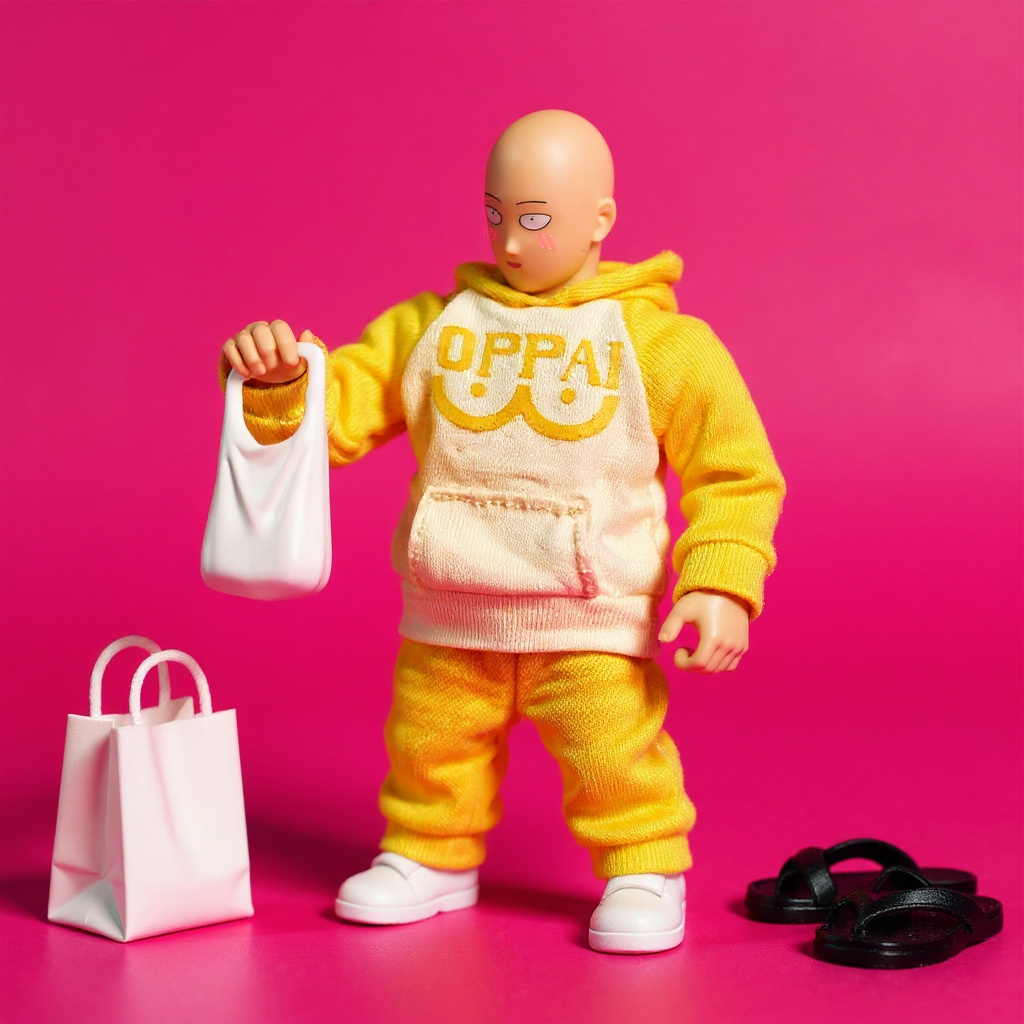
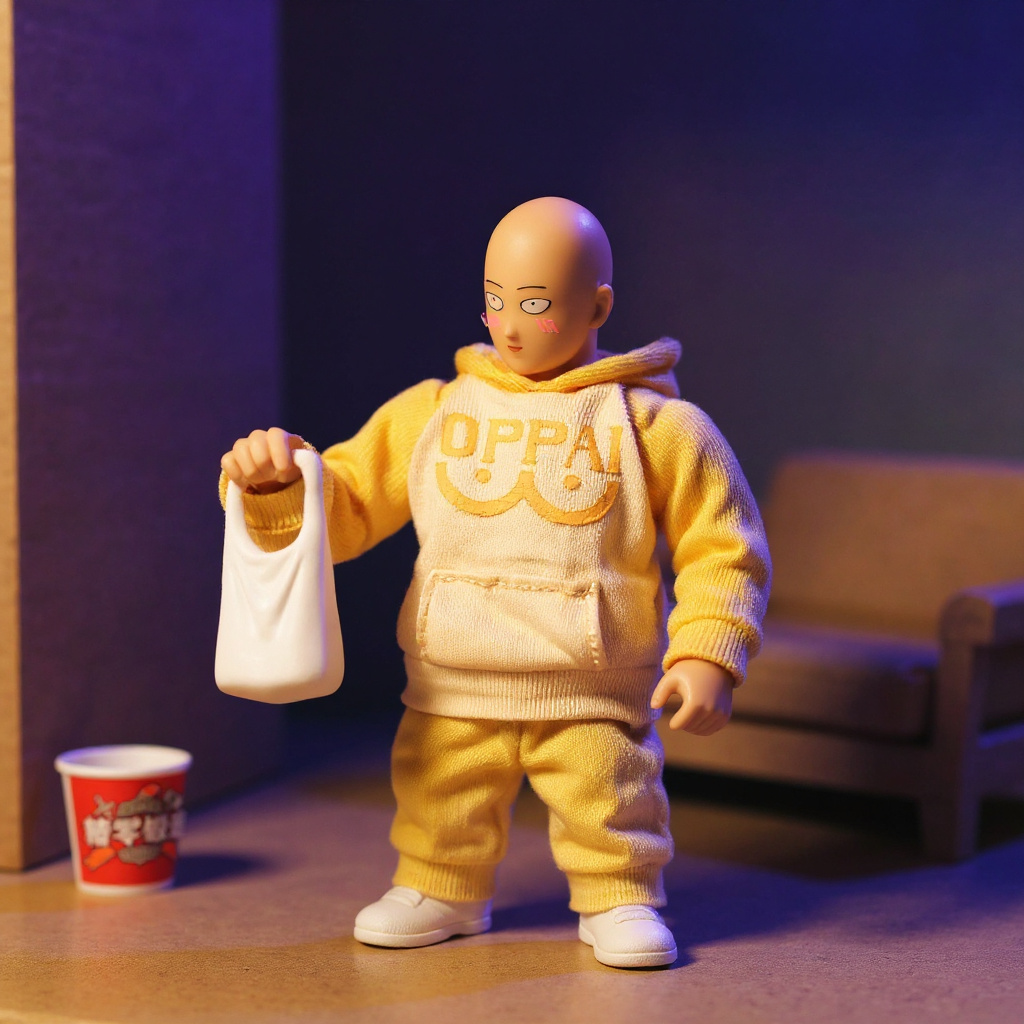
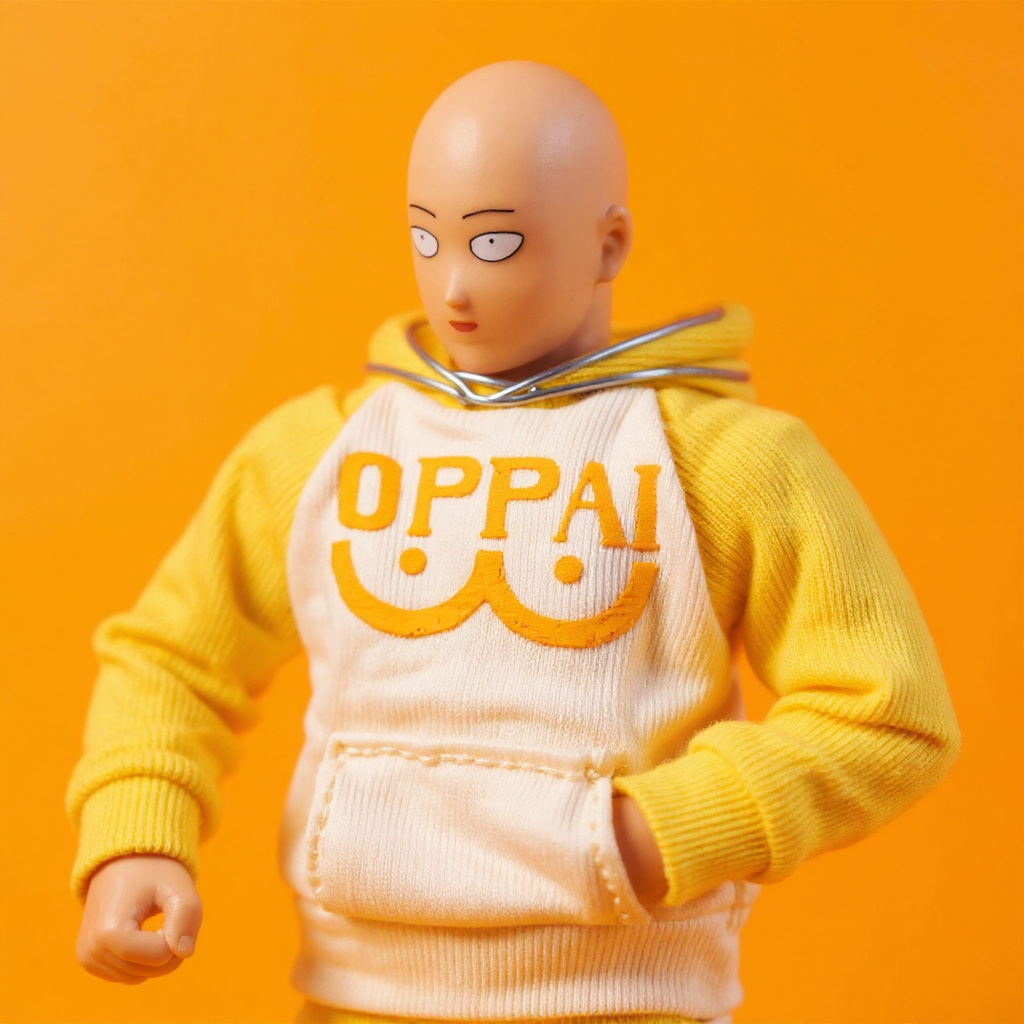
A good test of this approach is a loose, one-piece casual outfit. Take the Saitama Casual Outfit from The Figure Vault. It is a soft fabric, yellow jumpsuit-style outfit with white accents, sized for a 15 cm 1/12 figure. The stitching is done by hand and visible, and the fit is relaxed. Bendable wire runs inside the sleeves and collar. It is shown on a bald superhero body.
Here is why that design suits this kind of upgrade:
- Relaxed fit. A loose garment tolerates 2–3 mm of body variation between brands. Tight clothing does not. - Wire in the collar. A bald head has no hair to frame the neckline, so the collar shape carries the look. The wire lets you open it or flip it up. - Wire in the sleeves. You can bend a forearm to a punching or crossed-arm pose and the cloth stays put. - White accents. Contrast trim shows every scale error. If trim is too wide, you will see it at once.
There are trade-offs. Hand stitching means small irregularities, and that is part of the look. A loose jumpsuit also hides torso articulation, so you will not see the ab crunch or waist twist underneath. The price is $29.50, which sits inside the handmade range above.
Browse other soft goods in the full collection, or start from the Figure Vault home page.
How to Check Fit Before Buying: A 7-Step Routine
1. Confirm the figure's listed height on the manufacturer page. If it is 15 cm ±1 cm, 1/12 clothing is a reasonable match. 2. Measure shoulder width across the shoulder joints in millimeters. The baseline is 38 mm, and a loose garment tolerates ±3 mm. 3. Measure chest circumference with a paper strip, mark the overlap, and flatten it. Aim for about 85 mm. 4. Measure shoulder joint to wrist peg. The baseline is 53 mm. Add 2–3 mm if the cuff is meant to hang loose. 5. Check the neck. A wired collar needs 3–5 mm of clearance around the neck post. 6. Ask the seller for flat garment measurements in mm and a photo on a real body. Skip listings that offer neither. 7. Check wrist and ankle pegs. If hands swap out, make sure cuffs clear the peg.
How to Sew a Wired Sleeve or Collar: 8 Steps
Seam allowances are the big difference at this size. A 3 mm allowance equals 36 mm, about 1.4 inches, at human size. Keep them to 2–3 mm.
1. Cut a casing strip from cotton lawn, 10 mm wide and the length of the collar edge or cuff. 2. Fold each long edge in 2 mm and press flat. 3. Cut 28 or 30 AWG wire (about 0.32 or 0.25 mm across) 4 mm shorter than the casing. 4. Bend each wire end into a tiny loop. Sharp ends will poke through thin cotton. 5. Slide the wire into the casing with tweezers. 6. Whip-stitch the casing closed with 50-weight thread, with stitches about 1.5 mm long. 7. Attach the casing to the hem with a 2 mm seam. 8. Test the bend three times on the figure. If wire shows or shifts, re-stitch it.
Wire fatigue is real. Every bend hardens the metal, and eventually it snaps. Pose it. Photograph it. Leave it alone.
Avoid stretch fabric. It grabs the body and distorts the proportions.
Where to Source Quality Action Figure Clothing
- Etsy: the widest range of individual makers. Search for 1/12 or sixth-scale soft goods. Handmade outfits generally run $25–60. - eBay: cheaper, mostly from overseas sellers. Quality varies, so request close-up photos of the seams. - Official lines: Good Smile Company, Tamashii Nations, and Mezco sell accessory packs for specific characters. Check each product page for what is actually included, since many sets are plastic only. - Specialty shops: The Figure Vault carries handmade soft goods like the outfit above.
For background on the hobby itself, the action figure overview on Wikipedia covers scale conventions and history. For wire sizes, see the American wire gauge reference.
Cross-Brand Compatibility
Two figures can both be sold as 1/12 and still disagree by several millimeters. Torso depth, shoulder width, and peg design all vary.
A loose, wired garment absorbs these differences better than a fitted one. Footwear and tight cuffs do not. They fail first.
So compare millimeters, not brand names. If a seller lists flat measurements, you can check them against the table above in a minute.
Storage and Care
UV light fades dyes. That is well documented, and yellow fabric shows it soonest, so keep outfits out of direct sun. Store them in labeled plastic boxes, with wire sections left unbent.
Collectors also report dye transfer when dark fabric sits against light plastic for months, especially in warm rooms. Rotating outfits every few months helps, and so does a layer of acid-free tissue between cloth and plastic.
Honest take: if you live somewhere humid and cannot control it, think twice about fabric. Damp cloth can mildew and rust cheap wire. A silica gel packet in each box helps, but it is not magic.
Is a 1/12 Action Figure Wardrobe Upgrade Worth It?
It depends on what you do with the figure. Mass-produced plastic runs $8–15 and works for standing displays. Handmade fabric runs $25–60 and pays off when you pose, photograph, or build scenes.
Worth it for posing. Not worth it for shelf-sitters.

