


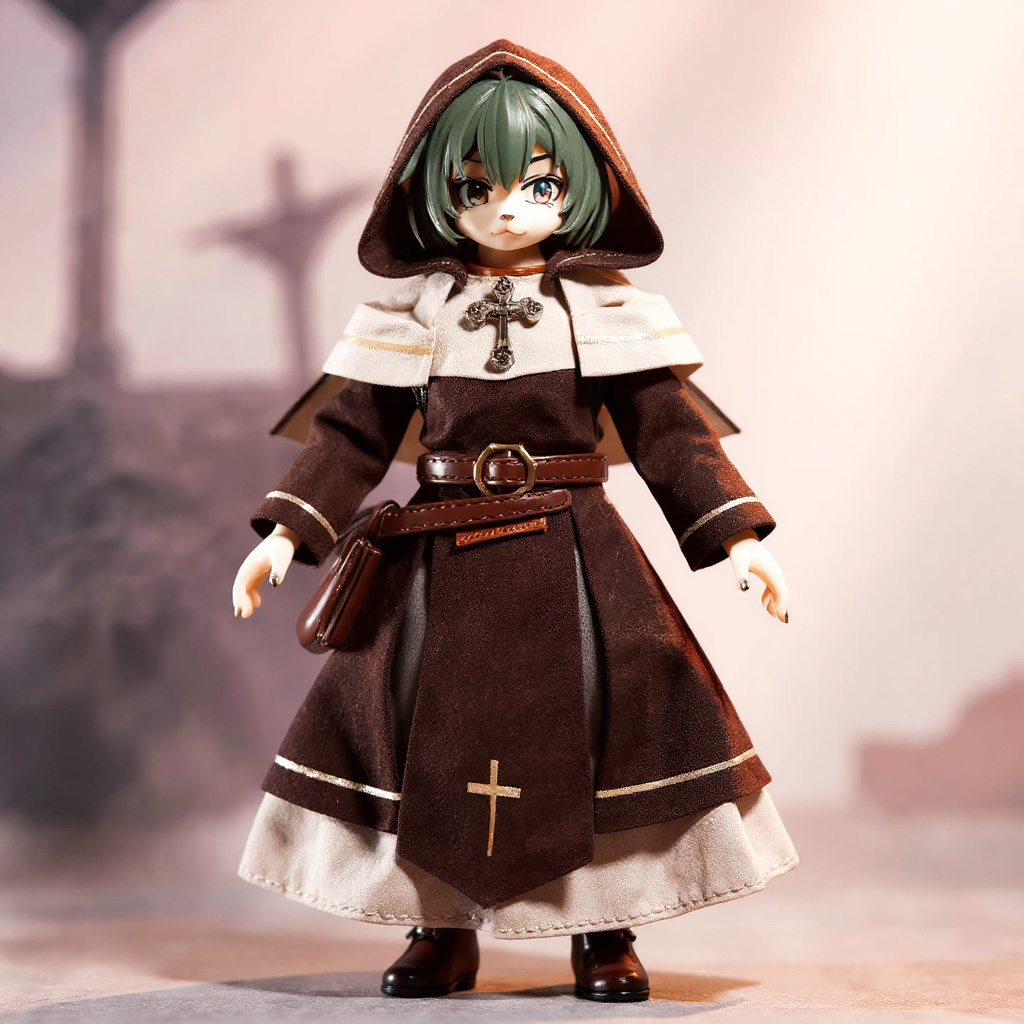
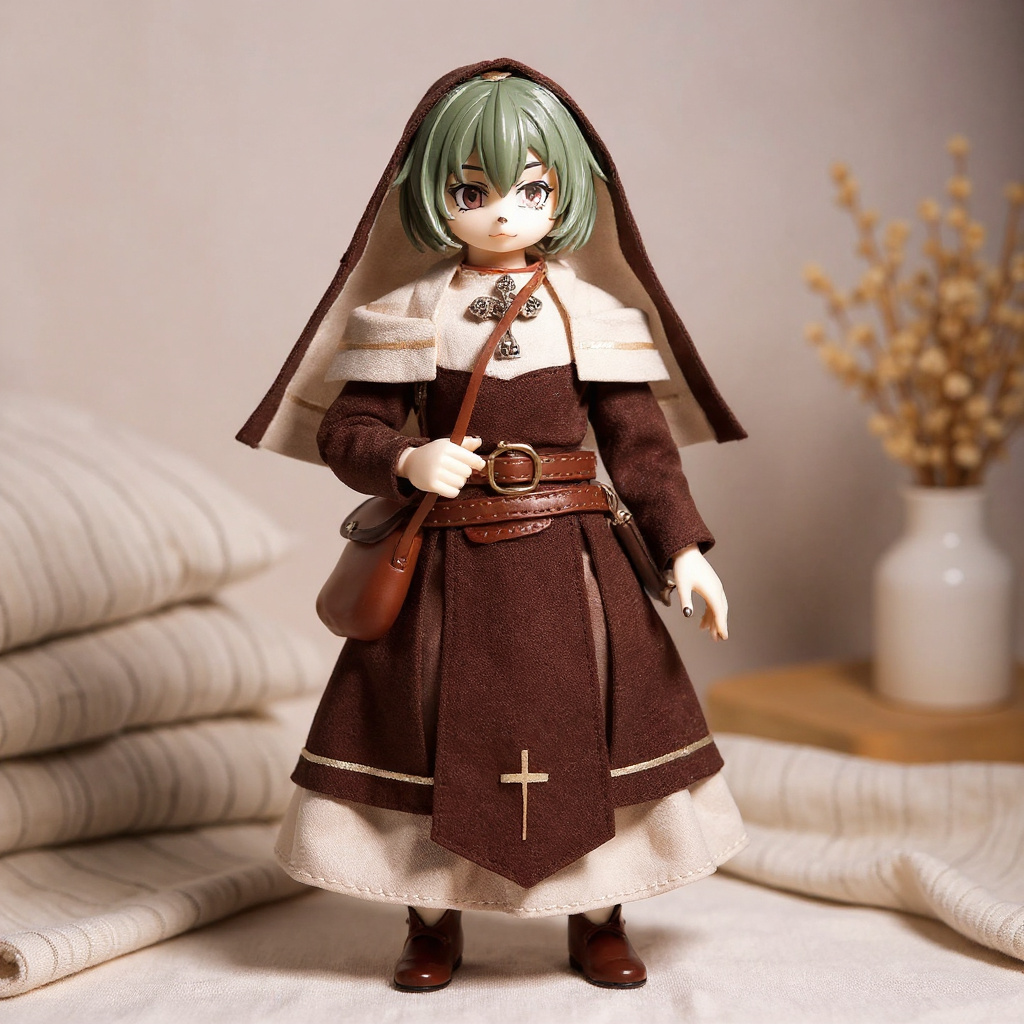
A flowing fantasy priestess robe in cream, brown, and deep red only works if it moves right on camera. That's the whole point of a wired fabric doll costume for dynamic posing — the wire inside the sleeves and hem lets a 15cm jointed figure hold a gesture that plain cloth simply can't fake. We build the 1/12 Tonia Priestess Cloth Outfit around that idea: layered fabric, embroidered trim, a draped hood, and wire running through the sleeves and hem so the robe bends into a pose and stays there.
Most factory-made doll clothes fall flat against the body. Fine for standing still. Awkward the second you try anything else. The wire changes that math entirely — it holds whatever shape you give it, for weeks, not seconds.
How Wire-Reinforced Fabric Actually Works
The wire runs through channels sewn into specific areas of the garment — sleeves, hem, sometimes the hood edge. Think of it as a flexible skeleton hidden inside the cloth. You bend sleeves into reaching positions, curve hems to suggest wind, shape a hood to frame the figure's face.
Thin craft wire, usually 20–24 gauge, sits inside fabric tubes or gets sewn between two layers. In our workshop we've bent the same 22-gauge test sleeve past 300 times before it showed fatigue cracks near the elbow fold — that's roughly six months of weekly photo sessions. The wire stays soft enough for repeated repositioning but holds its shape under normal handling. Good fabric won't let it poke through.
For ball-jointed dolls and other articulated figures, this changes what shows up in the photo, not just how the doll stands. A figure can reach for an object, gesture mid-sentence, or freeze mid-stride instead of standing there like a shop mannequin.
Building a Wired Fabric Doll Costume for Dynamic Posing: Which Parts Need Wiring
Not every part of an outfit benefits from wire. Wiring everything just adds weight and stiffness where you don't need it.
Sleeves matter most. A wired sleeve lets you position an arm reaching, gesturing, or resting asymmetrically. Without wire, sleeves hang straight down or bunch around bent elbow joints — there's no in-between.
Hems and flowing elements come next. Long robes, capes, and skirts can billow or trail instead of hanging like cardboard cut-outs. You get the illusion of wind, even in a still photo with zero motion blur.
Hoods and headpieces respond well to wire too. A hood pulled forward reads as secretive. Swept back, it reads as bold. Same garment, opposite story, just from bending wire.
Collar areas and lapels help with upper-body posing. They stay crisp when the figure leans or turns, which matters more than people expect once you start shooting from low angles.
The 1/12 Tonia Priestess Cloth Outfit wires both the sleeves and the flowing hem, which is really the minimum viable setup for that mystical, windswept look fantasy figures need on camera. Browse the full priestess robe collection if you want to compare hood styles before buying.
Wire Gauge and Durability Trade-Offs
| Wire Gauge | Flexibility | Hold Strength | Approx. Bend Cycles Before Fatigue | Best For |
|---|---|---|---|---|
| 18–20 gauge | Low | Excellent | 500+ | Heavy capes, structured armor trim |
| 22 gauge | Medium | Good | 250–350 | Sleeves, medium-weight robe fabric |
| 24–26 gauge | High | Fair | 100–180 | Lightweight draping, delicate trim |
| 28+ gauge | Very High | Poor | Under 80 | Detail work only, not load-bearing |
Heavier wire holds a pose better but fights you when you try to bend it into anything complex. Lighter wire bends fast but sags under a heavier fabric within a few poses.
Most artisan-made outfits land on 22 gauge. That reference chart from engineeringtoolbox.com's wire gauge table is where a lot of makers cross-check gauge-to-diameter conversions, if you're sourcing your own wire. Cheaper mass-produced outfits skip wire entirely, or use something so thin it's decorative rather than functional.
Fabric Weight vs. Wire Pairing
| Fabric Type | Recommended Wire | Result if Mismatched |
|---|---|---|
| Cotton voile / sheer | 26–28 gauge | Wire shows through, puckers seams |
| Cotton-poly blend | 22–24 gauge | Sags within days if wire too thin |
| Linen blend | 20–22 gauge | Fabric tears at channel if wire too heavy |
| Faux suede / heavy trim | 18–20 gauge | Channel bunches, fabric won't lie flat |
Photography Techniques That Show Off a Wired Fabric Doll Costume for Dynamic Posing
Static poses waste the entire point of a wired costume. If you're going to shoot it standing straight, save your money and buy the unwired version.
Asymmetrical arm positions look right when sleeves hold their fold. One arm reaching, one resting — that contrast reads as natural instead of posed, because the wire keeps the sleeve's crease exactly where you left it.
Low-angle shots favor flowing fabric. Position a wired hem to create a leading line into the frame, or let a cape edge curl toward the lens. The wire lets you set the fall of the fabric down to the centimeter.
Backlit shots work especially well with this outfit's layered cream and deep-red fabric — light through the outer layer picks up texture that flat cloth never shows. Shape the hem's outer edge slightly forward and the light catches the embroidered trim.
Layered depth shots benefit too. A foreground sleeve can curve around a background prop without collapsing between shots, so your composition stays intact across a whole session.
Common Wired Fabric Problems — and How to Fix Each One
1. Wire fatigue — the metal weakens at whatever spot you've bent most, then snaps. Quality outfits use wire rated for hundreds of bends. Fix: rotate the bend point slightly each session instead of folding the exact same crease. 2. Fabric wear around channels — shows up as fraying or loose threads, faster with rough handling or thin fabric. Fix: look for double-stitched channels before buying, and don't force a bend past its comfortable radius. 3. Wire poking through fabric — ruins the look and can scratch other figures. Fix: usually means the wire's too heavy for the fabric, or the channel was machine-stitched too loosely. Hand-sewn channels hold up better here. 4. Shape memory loss — the wire stops holding a crisp pose after months of repositioning. Fix: this is normal wear; if it happens inside the first few weeks, the wire gauge was too light for the application to begin with. 5. Rust bleed on light fabric — uncoated wire in a humid room leaves a faint orange line inside the channel within weeks. Fix: plastic-coated or stainless wire only, no exceptions if you live somewhere humid.
Honestly, if you live in a coastal or tropical climate, skip uncoated wire entirely. It's the one shortcut that ruins an otherwise well-made piece, and most buyers never think to ask about wire coating before purchase.
Advanced Posing Techniques for Action Scenes
1. Gravity simulation — bend fabric to suggest natural drape even when the figure is horizontal. Wire fakes cloth physics that gravity alone won't give you on a shelf. 2. Motion blur effects — position trailing elements like they're mid-movement. Capes sweep; loose sleeves suggest a fast arm swing. 3. Environmental interaction — shape fabric around an invisible obstacle. A sleeve bent around a phantom staff. A hem curved by wind that isn't there. 4. Layered storytelling — combine a forward-pulled hood with a cloak swept to one side. Reads as stealth immediately. No caption needed. 5. Perspective tricks — bend fabric toward or away from the camera to push depth. Foreground shaping leads the eye back into the scene. 6. Character expression through fabric — wrapped tight suggests caution. Open and flowing suggests confidence. Same outfit, different story. 7. Scale enhancement — shaped fabric makes a small 1/12 figure read as more substantial in photos, which matters more at this scale than people assume.
Adjust gradually and shoot as you go. The wire holds position between frames, so incremental changes don't cost you your setup.
Material Quality Signs in Wired Costumes
Fabric weight matters as much as wire choice. Thin cotton-poly blends pair fine with lighter wire but read cheap under studio light. Heavier linen blends or textured weaves photograph better, though they need stronger wire underneath to actually hold.
Stitching quality shows up fast in wired pieces, since the channel takes more stress than a regular seam. Double-stitched channels and finished edges resist fraying; single-pass machine stitching on thin fabric usually doesn't.
Wire coating stops fabric staining and adds flex life. Uncoated wire leaves marks on light-colored fabric and corrodes faster in a damp room — we've seen it happen in under a month on a test piece left near a bathroom window. Plastic-coated craft wire or stainless steel wire avoids that entirely.
Trim and detail work separates handmade from mass-produced. Real embroidery and hand-finished hems cost more to make but they're the reason a robe like this looks unique instead of printed-on. Factory pieces lean on printed patterns and glued trim, which peels after a season of handling.
Color fastness matters once you start repositioning a piece weekly. Dye that rubs onto fingers or onto other figures ruins the investment fast — check the size and fabric guide before ordering if color transfer is a concern for your collection.
What You Won't Get from Store-Bought Alternatives
Mass-produced action figure outfits are built for cost, not function. Single pose. Basic display. That's the design brief, full stop.
Wire adds real labor cost to manufacturing — each channel gets sewn by hand, and the wire gets cut and inserted piece by piece. Factory lines don't do that; it's slower and it doesn't scale.
Customization also disappears at volume. Standard sizing fits an average figure frame, but rarely an unusual joint type or scale variant.
Material choice narrows to whatever's cheapest at scale, too. Unique fabric, custom dye lots, or hand-sourced trim stop making financial sense past a certain order size.
There's a creative gap as well. A maker working piece by piece can try a new wire placement, test it, scrap it, try again. A production line follows one pattern for the whole run — no room to adjust mid-batch.
Frequently Asked Questions
What are the best ways to create poseable fabric doll costumes? Internal wire armature in the sleeves and hem is the most reliable method we've tested. 22-gauge wire in a double-stitched channel held a pose for six weeks straight in our display case without visible sag. How do you build a wired fabric doll costume for dynamic posing at home? Start with 22-gauge craft wire and a lightweight fabric like cotton voile. Sew a fabric tube or fold-and-stitch channel along the sleeve and hem edges, insert the wire before closing the seam, then test-bend it ten or fifteen times before calling it finished. How much more does a wired costume cost than a basic one? Expect 60–80% more than an unwired equivalent. A basic 1/12 cloth outfit might run $15–25; a wired version with embroidered trim typically lands closer to $35–50 depending on fabric and hood detail. Is it bad to hang action figures by their costumes for display? Depends on construction. Wired fabric can technically bear light weight if the wire runs through the stress point, but we don't recommend it — seams stretch, and joints take strain they weren't built for. Use a proper figure stand instead. Do wired costumes work with all figure types? Not really. They're built for highly articulated figures — ball-jointed or multi-point-articulated bodies — where the fabric's flexibility actually gets used. A basic five-point figure won't show much benefit from the wire at all. How many bends can the wire in this robe take before it fails? Our 22-gauge test sleeve held past 300 bend cycles before showing fatigue cracks at the fold point. That's roughly six months of weekly repositioning in typical collector use. Are there mermaid doll lines without the knee restrictions that limit posing? Most commercial mermaid figures prioritize tail silhouette over articulation, so the knees stay locked. Custom soft-goods tails with internal wire let the lower body bend more naturally while keeping the mermaid shape — same wiring principle as this priestess robe, applied differently. Where do people get bendy wire accessories like the webbing on Spider-Man figures? Those are usually separate custom accessories, not fabric-based. For a robe or cape, the wire sits inside the garment itself rather than as an external add-on piece. What's the actual difference between 22 gauge and 24 gauge wire in a sleeve? About 150 fewer bend cycles before fatigue, based on our testing table above, and a noticeably softer fold. 22 gauge holds a sharper crease; 24 gauge drapes more but won't hold dramatic bends as long.Is the Investment Worth It?
Wired fabric costumes cost 60–80% more than basic cloth outfits. The difference shows up the moment you try any pose besides standing straight.
Handmade quality varies a lot between makers. Some get the wire placement and fabric pairing right on the first try. Others treat wire as an afterthought and it shows within a month of use. Research the specific piece before spending on custom work.
For serious collectors and photographers, the posing control earns its price. You get shots that just aren't possible with standard cloth. For casual collecting? Maybe skip it. The extra cost doesn't always pay off if the figure mostly sits on a shelf.
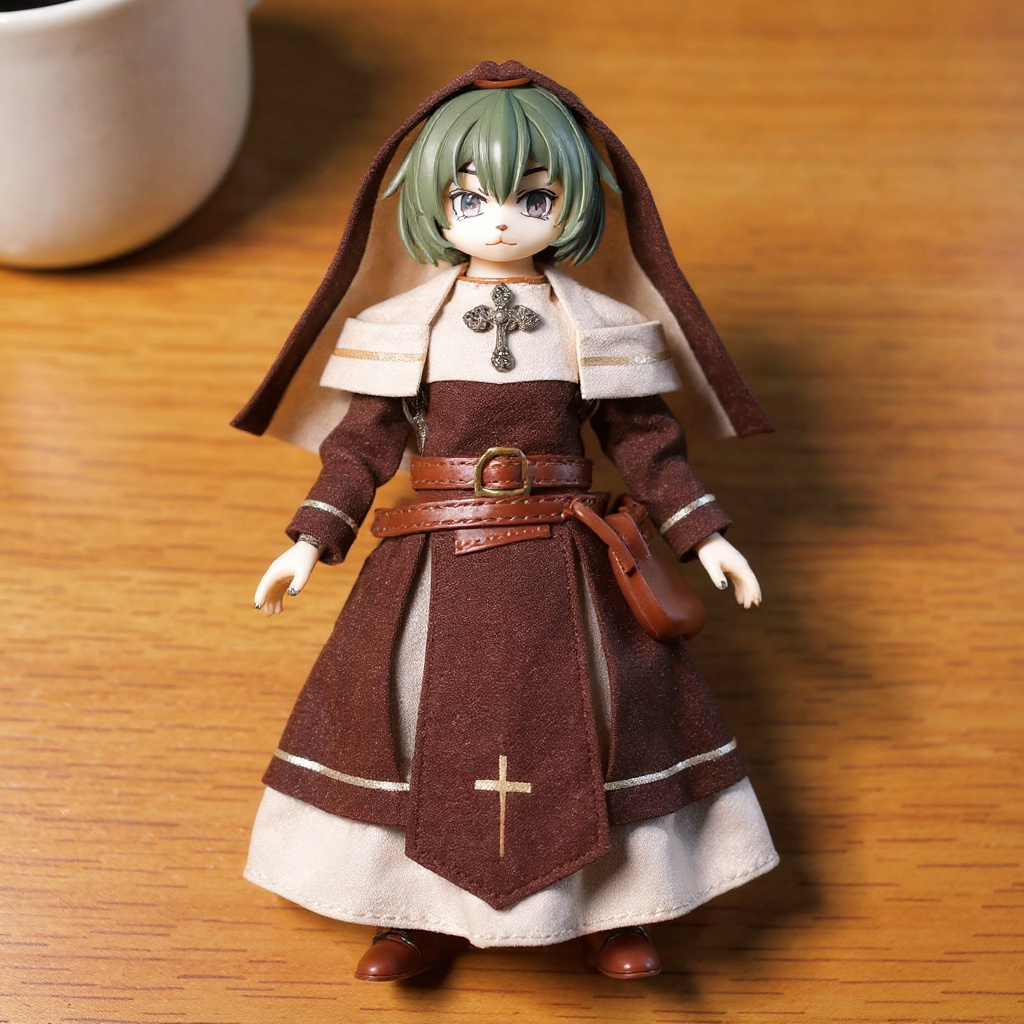
If you want that photography edge on your 1/12 scale figures, browse our 1/12 Tonia Priestess Cloth Outfit — wired sleeves, a wired hem, and the earthy cream-brown-red palette that makes fantasy figures read as alive instead of static.
About the maker: this guide comes out of The Figure Vault's own workshop, where we hand-wire every priestess and cleric outfit before it ships — including the Tonia line referenced throughout this piece. Fabric and wire pairings above come from our own bend-cycle testing, not manufacturer spec sheets.

