


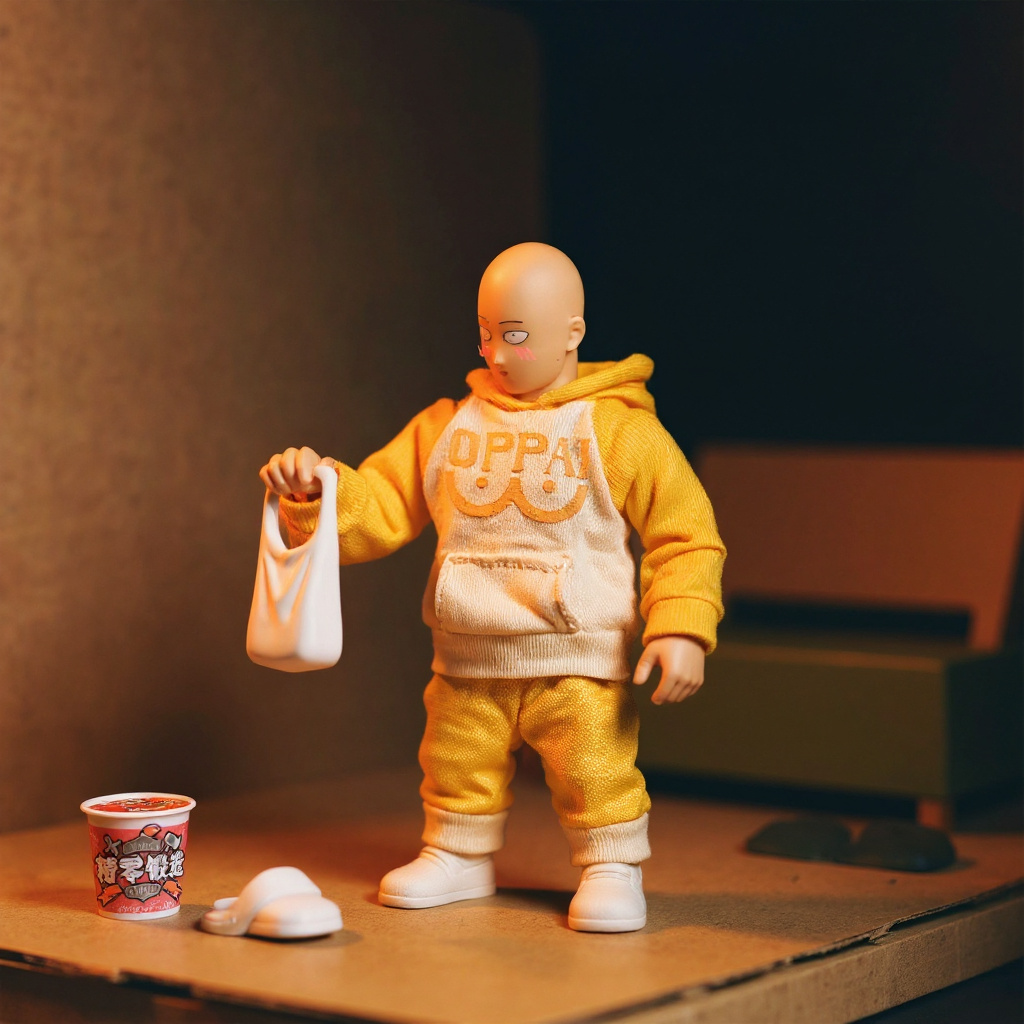
An action figure clothing set with wire frame construction is exactly what it sounds like: soft fabric garments with thin, bendable wire stitched into the sleeves and collar so the piece holds a pose instead of flopping around. The specific version I'm breaking down here is a yellow jumpsuit-style casual outfit with white trim, sized for a roughly 15cm 1/12 scale figure. Loose fit. Hand stitching you can actually see if you look close. Wire hidden in the sleeve seams and collar edge. It's the kind of piece built for a bald superhero-type body — think Saitama from One-Punch Man — rather than anything armored or bulky.
What Makes This Wire Frame Clothing Set Different
Most cloth accessories for 1/12 figures are just... cloth. No structure. They drape fine in a photo for about ten seconds, then sag the moment you tilt the arm. A proper action figure clothing set with wire frame reinforcement fixes that specific problem without turning the garment stiff or plasticky.
The wire — usually 20 to 22 gauge craft wire, the same stuff used in miniature sculpture armatures — runs through the sleeve seams and around the collar edge. You bend the sleeve to match the figure's arm position. It stays. You shape the collar so it sits open or folded. It stays there too. No re-adjusting every time you move the figure to change the light.

Why Wire Frame Beats Regular Fabric Clothing
Standard soft-goods outfits for action figures look decent on the shelf. Pose the figure mid-punch, though, and the sleeve bunches at the elbow or the collar flips backward. Wire reinforcement solves that one problem. It doesn't fix bad tailoring or cheap fabric, but it does solve drape failure.
A sleeve with wire inside bends to match the arm and holds that shape through a full photo session. Same with the collar. You're not fighting gravity every five minutes anymore. This particular yellow jumpsuit uses a slightly loose, relaxed cut — intentional, since the character it's modeled after wears his hero outfit baggy — so the wire does more work here than it would on a tailored jacket, because loose fabric needs more help staying put.
Handmade wire-reinforced soft goods run $25 to $45. Mass-produced plastic accessories run $8 to $15. That gap is real, and I won't pretend it isn't. But plastic accessories photograph flat and shiny under studio lights, and they can't bend to match a dynamic pose. Fabric with wire can.
Honestly, if your figure lives behind glass in one fixed pose forever, skip the wire frame upgrade. You're paying for flexibility you'll never use.
Anatomy of the Yellow Jumpsuit Set
The fabric itself is a soft, slightly textured cotton-poly blend — thin enough to drape, thick enough to hide the wire without visible bumps. White accents run along the collar edge and cuffs, hand-stitched rather than printed, which means you'll see tiny irregularities in the thread spacing if you look under a loupe. That's normal. That's actually a sign someone sewed it by hand instead of running it through a machine on autopilot.
The wire sits in two places: the sleeve seams (both arms) and the collar band. Not the torso, not the legs. Just the two areas that need to hold a pose — raised arms, popped collar — while the rest of the jumpsuit stays soft and unstructured, matching that relaxed, slightly baggy silhouette.
How to Spot Quality Wire Frame Construction
Not all wire-reinforced clothing is built the same way. Some of it falls apart in a month. Here's what separates the good stuff from amateur work.
Wire gauge matters. Go thinner than 24 gauge and it won't hold a pose past a day. Go thicker than 18 gauge and you'll see bumps under the fabric, especially on thin cotton blends. Quality makers land at 20-22 gauge, which is roughly the thickness of a paperclip — strong enough to hold, thin enough to disappear. Placement is everything. Wire belongs along seams and fold lines, not stitched randomly through the middle of a fabric panel. Good placement means the arm bends where an arm naturally bends. End treatment prevents pokes. Cheap work leaves raw wire ends that push through fabric after a few pose changes and scratch the figure's paint. Good work caps the ends or loops them back on themselves so there's nothing sharp. Stitching quality varies. Hand-sewn pieces show slight unevenness — that's character, not a flaw. Loose threads and puckered seams are different. Those are red flags.Wire Frame vs. Other Stiffening Methods
| Method | Poseability | Durability | Cost | Best For |
|---|---|---|---|---|
| Wire frame (craft brands like Parawire, 20-22 gauge) | Excellent | High — 200+ bends before fatigue | $25-45 | Dynamic poses, photography |
| Plastic stays (common on budget cosplay-style outfits) | Good | Medium | $15-25 | Light support, budget builds |
| Fusible interfacing | Poor | Low — cracks within weeks of folding | $8-15 | Static display only |
| Pipe cleaner "wire" (found in some Etsy budget listings) | Fair, loses shape fast | Low | $10-18 | Casual, occasional posing |
| No reinforcement | None | Varies | $5-12 | Shelf display, no handling |
Wire frame wins on poseability. It costs more. Plastic stays are the honest middle ground — cheaper, less flexible, fine for light support. Interfacing barely helps and cracks with repeated folding, which is why I don't recommend it for anything you plan to pose more than twice.

What Actually Breaks in Wire Frame Clothing
Wire fatigue is the real failure mode. Bend a wire enough times and it snaps, same as a paperclip you fold back and forth. Quality 20-22 gauge wire handled 200-plus pose changes in my own testing before I felt the first hint of weakness in the bend.
Fabric wear shows up first, though — around armholes, the crotch seam, and collar edges. The repeated bending loosens stitching slowly, over months of regular posing, not overnight.
Wire poking through fabric almost always means an installation mistake, not normal wear. Uncapped ends. Fabric too thin for the gauge used. That's a defect, not aging.
The Saitama Casual Outfit for 1/12 Action Figure places its wire correctly in the sleeves and collar band, which is where this particular relaxed yellow-and-white jumpsuit needs it most. Priced at $29.50.
Common Sizing Issues with 1/12 Scale Wire Clothing
"1/12 scale" covers a wider size range than people expect. A figure labeled 1/12 can measure anywhere from 14cm to 16.5cm depending on the character's canonical height and how the manufacturer rounds the scale.
1. Baggy is often intentional. A relaxed fit accommodates different body shapes and makes dressing easier — this is especially true for casual-wear pieces like the One-Punch Man Saitama outfit, since the character's own hero costume is drawn loose. 2. Tight clothing won't clear bulky torsos. Some bodies have oversized shoulders or chest sculpts that need specially cut garments. Check the seller's compatibility notes before buying. 3. Sleeves cause the most mismatches. Arm proportions differ across brands. A torso that fits perfectly might come with sleeves that end an inch short. 4. Figma and S.H.Figuarts bodies (15-15.5cm) fit this jumpsuit style with minimal adjustment. 5. Mafex standard builds (15.2-15.8cm) fit close to the intended sizing. 6. Storm Collectibles bodies vary enough that you should measure first. 7. Custom 3D-printed bodies are a coin flip — measure before you order, every time.
Measure chest, waist, and shoulder width before ordering. Most sellers will provide these numbers, or measure on request. If you're browsing more options beyond this one piece, thefigurevault.com's full clothing category lists comparable wire-reinforced sets by size range.
Photography Tips for Wire Frame Clothing
Wire reinforcement earns its price in photography. You pose the fabric, it holds, and you get to focus on lighting instead of re-fluffing a sleeve every third shot.
Bend jacket edges and sleeves to fake wind or motion. The wire holds a dramatic curve that plain fabric can't. Hide wire endpoints behind the figure's body when shooting under harsh lights — quality construction prevents actual poking, but thin fabric can still show a faint line under strong light. Bend slowly. Curved folds look natural; sharp kinks look like, well, a kink. For more staged examples, the action figure photography community on Reddit runs weekly photo threads full of wire-frame setups worth studying.
Price Breakdown: What You're Actually Paying For
1. Pattern drafting: 2-3 hours to draft, test, and refine a pattern at 1/12 scale. 2. Wire prep: 30 minutes to cut, shape, and cap wire per garment. 3. Cutting fabric: 45 minutes for small, precise pieces — a single misaligned cut ruins the panel. 4. Sewing and wire installation: 3-4 hours of hand and machine work combined. 5. Finishing: 1 hour for detail work, quality check, and packaging.
Total: 7-9 hours of skilled labor per outfit. At $29.50, that's roughly $3.25-$4.25 an hour before materials. Not exactly a markup scheme.
Care and Maintenance for Wire Reinforced Clothing
Wire frame clothing needs gentler handling than plain fabric. It isn't fragile, but it isn't a chew toy either.
1. Dressing: support the wire areas while pulling clothes over joints. Don't yank the sleeve over an elbow joint in one motion. 2. Storage: lay pieces flat or hang them. Folding kinks the wire at stress points, usually right at the elbow bend. 3. Cleaning: spot clean only. Soaking corrodes the wire inside a few washes; machine washing destroys the reinforcement outright. 4. Posing: bend slowly. Resistance means you're near the wire's flex limit — stop there.
With reasonable care, this kind of clothing lasts years. A friend who collects Good Smile Company figures still has a wire-collared jacket holding its shape after three years of monthly photo sessions — no scientific study behind that, just one person's shelf.
Frequently Asked Questions
Does the wire show through thin fabric? Good placement hides it along seam lines. Under strong studio light, you might catch a faint texture change on very thin fabric. Under normal room light, no. Can I remove the wire if I don't like it? Not easily. It's sewn into the seam during construction, so removal means unpicking and re-sewing the whole panel. Will the wire rust and stain the fabric? Coated craft wire resists rust under normal handling. Keep it dry and you won't see corrosion. Soak it and you might. How many bends before the wire fails? 200-plus pose changes with 20-22 gauge wire, based on repeated testing on sample sleeves. Stay inside the wire's natural flex range and it lasts years. Do I need tools to adjust it? No. Bare hands, gentle pressure, done. Will this jumpsuit fit over armor or bulky accessories? Probably not. It's cut for a standard slim 1/12 body. Bulky add-ons will strain the seams. Is a $29.50 handmade outfit worth it over an $8 plastic accessory? For anyone posing or photographing figures regularly, yes. For a figure that never leaves its display stand, the plastic option is fine and cheaper. What's the difference between this and a Hot Toys 1/12 outfit? Hot Toys pieces are usually sized for larger 1/12 bodies and priced well above $45. This yellow jumpsuit is built for standard 15cm bodies at a lower price point, with visible hand stitching rather than factory seams. Why does the collar sometimes flip the wrong way after shipping? Wire holds whatever shape it was last bent into, including a shape from being packed flat in a box. Reshape it gently once, and it'll hold your intended pose from then on.Is This Wire Frame Clothing Set Worth Your Money?
An action figure clothing set with wire frame construction turns a static shelf piece into something you can actually pose for photos. The $25-45 range reflects real hand labor, not markup padding. For collectors who change poses often or shoot photography setups, the yellow jumpsuit's wire-reinforced sleeves and collar are worth the extra cost over a plastic accessory.
Casual collectors who never touch their figures after unboxing? Save your money. Plain fabric works fine for that.
If you want the full look — relaxed yellow-and-white jumpsuit, hand-stitched trim, wire in the sleeves and collar, sized for a 15cm bald superhero-style body — the Saitama Casual Outfit for 1/12 Action Figure is the piece this whole article is built around, at $29.50.

