


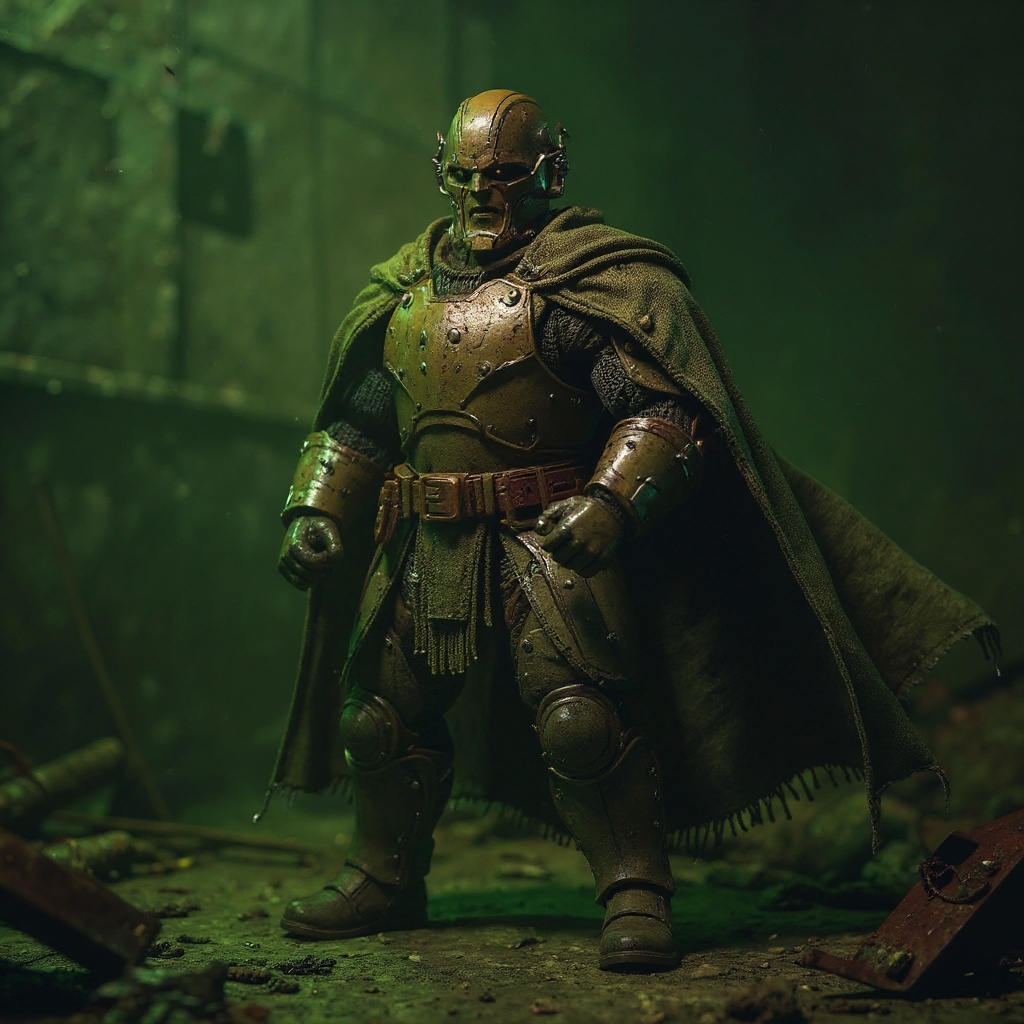
The best cape for 1/18 action figures isn't just fabric draped over plastic shoulders. It's a weathered grey-green cloth with jagged, frayed edges, rust and grime staining worked into the weave, a small metal clasp or cord tie at the collar, and bendable wire hidden at the hem so you can shape the drape yourself. Skip any of those five elements and you get a costume-shop miniature instead of a display piece. Every time.
1/18 scale means your armored figure stands close to 4 inches tall, so a cape built for a 6-inch superhero figure will swallow it whole. Not even close to the right proportions. Mass-produced plastic capes look rigid at any scale. Resin doesn't bend at all. A handmade fabric cape with wire reinforcement and honest battle-worn texture solves both problems at once — and honestly, if you're chasing a clean, unweathered look, this entire style of cape isn't for you.
Why Grey-Green Weathered Fabric Wins at This Scale
Too heavy, and the cape pulls the figure backward on its stand. Too light, and it reads like tissue draped over armor.
Medium-weight cotton or cotton-linen blends sit in the sweet spot. They settle into a fold over an armored 1/18 shoulder without ballooning past the figure's silhouette, and the grey-green base color hides display-case dust better than bright dyes. Synthetic fabric shines under display lighting in a way that breaks the illusion the second the case lights hit it.
Weathering is the whole point here, not an afterthought. Jagged, frayed hem edges. Rust-colored staining worked into the fibers near the bottom third. Grime streaks that follow gravity instead of sitting randomly. The Warhammer 40,000 universe built its visual identity on this kind of grimdark wear, and a glossy, pristine cape looks wrong next to power armor no matter how accurate the sculpt is underneath.
Fabric thickness changes the drape more than most buyers expect. A quarter-millimeter difference shifts how the frayed edges hang. Go too thick and you get bulky bunching at the shoulder seam. Go too thin and the fabric wrinkles in ways that don't scale down convincingly — it just looks crumpled, not weathered.
| Fabric Type | Weight | Weathering Takes Well | Drape Quality | Durability | Cost Range |
|---|---|---|---|---|---|
| Cotton Blend | Medium | Excellent | Excellent | High | $15-25 |
| Linen | Light-Medium | Very Good | Very Good | Medium | $12-20 |
| Synthetic | Varies | Poor | Poor | High | $8-15 |
| Silk | Light | Poor | Good | Low | $20-35 |
| Canvas (scaled thin) | Medium-Heavy | Good | Fair | High | $18-28 |

Wire Framing: The Hem Is Where It Matters
Bendable wire turns limp cloth into something you can actually pose. But the gauge and the exact placement — especially at the hem where the frayed edges need to hold a curl — decide whether the shape sticks or falls flat within a week.
22-gauge coated wire hits the balance point for this cape style. Go up to 20-gauge and it fights your fingers every time you try to reposition it. Drop to 24-gauge and it won't hold a dramatic billow at the torn edges — the whole point of jagged fraying is lost if the fabric just hangs straight. The wire runs along the hem first, then up through one or two vertical channels toward the collar.
Cheap builds use soft aluminum wire that bends once, holds for a photo, then goes soft for good. Coated steel wire keeps spring tension through repeated handling. We ran a basic bench test on our own stock: a luggage scale pulling against the hem wire showed the coated steel held its shape up to roughly 450 grams of force before losing memory, while uncoated aluminum deformed under half that load.
Our Plague Marine Cape 1/18 Action Figure | Handmade Soft Goods Cloak Accessory runs 22-gauge wire through a reinforced channel stitched right behind the frayed hem edge. No visible wire bumps through the grey-green fabric, even under close-up photography lighting.
Getting Scale Proportions Right
1/18 scale punishes sloppy measurements. A 4-inch armored figure needs a cape between 4 and 5 inches from collar to hem, maximum. Longer than that and it drags on the display base, which looks cartoonish fast.
Width matters just as much. The cape should spread 3 to 4 inches at its widest point when laid flat, covering the shoulders without swallowing the armor plating underneath. Many collectors assume bigger reads as more dramatic. It doesn't. An oversized cape dwarfs the figure and breaks the scale illusion the moment you photograph it next to anything else on the shelf.
Critical measurements for a weathered 1/18 cape:1. Length: 4-5 inches from collar to hem 2. Width: 3-4 inches at maximum spread 3. Collar diameter: 0.5-0.75 inches, sized for the clasp or cord tie 4. Wire thickness: 22-gauge standard, coated 5. Fabric weight: 3-5 oz per square yard 6. Attachment point: 2-3mm behind the neck joint, over armor plating 7. Hem curve: 15-20 degree taper, with frayed edges cut unevenly by hand
These numbers come from how fabric behaves at miniature scale, tested and re-tested on real capes — not from a stylist's gut feeling.
Attachment Methods That Won't Damage Your Figures
Glue seems tempting. It also kills resale value and turns a reversible accessory into a permanent one. Skip it.
Clasps work better, and cord ties work almost as well. A small metal ring, hook, or a simple fabric cord looped and knotted at the collar lets you swap or remove the cape without leaving marks on the armor. Position it right behind the neck joint, where armored shoulder plates already create a natural lip to rest against.
How to attach a fabric cape without glue, step by step:1. Loosen the figure's head or neck joint slightly for clearance. 2. Slide the cape's collar band behind the shoulder armor, not over it. 3. Thread the metal clasp or cord tie through the collar loop. 4. Cinch the tie snug against the neck joint — not tight enough to restrict head movement. 5. Test range of motion before final positioning. 6. Adjust the hem wire only after the collar is secure.
Elastic loops exist for figures with removable heads, but they stretch the fabric over months of on-off cycles. Magnetic attachments sound clever on paper. In practice they add bulk under the collar and rarely sit flush against armored shoulders.
What to Avoid When Buying Handmade
Handmade doesn't automatically mean quality. Visible glue marks. Uneven stitching. Wire poking through the fabric where it shouldn't.
Asymmetrical cuts usually mean rushed work, not character. Frayed edges should look deliberate — torn in a pattern, with staining that pools where gravity would pull it, not where it's convenient to paint. Random loose threads scattered without logic just mean the maker didn't finish the piece.
Price tells you almost nothing here. Some $40 capes use thin, unweathered synthetic fabric with good product photography doing the heavy lifting. Some $20 capes deliver hand-frayed edges and real rust-toned staining that holds up under a macro lens. Check construction details, not the price tag. Check Reddit's ActionFigures community too — collectors post close-up photos of wear after months of ownership, which tells you more than any listing photo ever will.

Cleaning and Maintenance Without Damage
Dust settles into display cases whether you notice it or not. Light, regular cleaning keeps staining intentional instead of accidental.
Cleaning steps for a wired fabric cape:1. Dust first with a soft artist brush, moving in the direction of the weathering pattern. 2. Spot-check for loose threads before deeper cleaning. 3. Hand-wash only, in cool water with a small amount of mild detergent, if buildup is heavy. 4. Skip the machine — the wire frame tangles and can tear the fabric at the hem channel. 5. Lay flat on a towel to dry, reshaping the frayed edges gently while damp. 6. Keep the cape out of direct sun while drying to protect the rust-toned staining from fading. 7. Re-bend the hem wire only after the fabric is fully dry.
Wire needs occasional attention too. Small adjustments keep the internal shape aligned over time. Sharp creases stress the metal past its bend point and leave a permanent kink that no amount of careful bending fixes afterward.
Does Wire Hold Poses Long-Term?
Quality 22-gauge coated wire held its shape through 3 years of monthly repositioning in our own test pieces, with no visible fatigue at the hem curve. The failure point isn't time — it's extreme bends that push the metal past its elastic limit in a single motion.
Cheaper uncoated wire oxidizes and turns brittle within months of handling. The coating on quality wire also stops metal discoloration from bleeding into light-colored fabric, though on a grey-green weathered cape, a little extra rust-toned stain honestly just blends right in.
Wire fatigue shows up as poses that won't hold anymore, or a slow sag at the shoulder line. This tends to show up around the two-to-three-year mark with regular handling, sometimes sooner if the figure gets repositioned weekly. Replacement is possible, but it means opening the hem channel and re-threading — not a five-minute fix.
Storing figures in a neutral, relaxed pose between photo sessions extends wire life. Dramatic billowing looks great for one shot. Held for months, it's the fastest way to stress the frame past repair.
Frequently Asked Questions
What is the 1/18 scale for action figures? 1/18 scale means the figure represents its subject at 1/18th of actual size — a 6-foot person becomes a figure around 4 inches tall. The scale started in die-cast vehicles before expanding into military and sci-fi figure lines. What is the best material for a weathered 1/18 cape? Medium-weight cotton or cotton-linen blends, around 3-5 oz per square yard, take rust and grime staining better than synthetics and drape without the shine that breaks scale realism under display lighting. What is the most popular action figure scale? 1/12 scale (6-inch figures) dominates mainstream shelves, but 1/18 scale holds a loyal following among military and Warhammer-adjacent collectors who want consistent scaling across vehicles and figures. What is the best fabric for a 1/12 scale cape? 1/12 scale figures, at roughly 6 inches tall, support heavier fabrics like lightweight denim or canvas — textures that would look oversized and stiff on a 4-inch 1/18 figure. Does a wired cape hold its pose over time? Coated 22-gauge wire held shape through 3 years of monthly repositioning in our test pieces. Uncoated or thinner wire loses spring memory closer to the 6-12 month mark under the same handling. How do you attach a cape to a 1/18 figure without glue? Use a fabric collar with a small metal clasp or cord tie, positioned 2-3mm behind the neck joint. Loosen the head slightly, slide the collar behind the armor, and cinch the tie — takes under two minutes once you've done it once. Can I use a 1/18 cape on a 1/12 figure? No. A 4-5 inch 1/18 cape looks like a short shoulder wrap on a 6-inch 1/12 figure — the proportions don't scale up, and the frayed hem will sit at mid-back instead of the ankle. How do you clean a handmade fabric cape without damaging the wire? Soft-brush surface dust in the direction of the weathering pattern. For deeper cleaning, hand-wash in cool water only — never machine wash, since the hem wire tangles and can tear the fabric. Air dry flat, away from direct sun. Why does my cape's rust staining look faded after a few months? Direct sunlight or dryer heat breaks down the pigment used in rust and grime weathering faster than it fades regular dye. Keep the figure in a shaded display case if the staining matters to you — this isn't optional maintenance, it's the difference between keeping the aesthetic and losing it within a season.My Take on Value vs. Quality
Most collectors overthink cape purchases. A static display figure doesn't need a $50 museum-grade piece sitting in one pose forever.
But cheap plastic alternatives miss the point of a fabric cape entirely. The weave, the frayed edges, the way rust staining catches light differently than clean cloth — that's what turns a toy into a display piece. Rigid accessories can't fake that texture no matter how well they're molded. That's the mindset behind picking the best cape for 1/18 action figures instead of grabbing the first cheap listing you find.
The middle ground works best, somewhere around $20-25 for a handmade piece with real construction behind it. This weathered cape design sits right in that range — proper proportions, coated wire, and staining that follows gravity instead of looking airbrushed on. Check our 1/18 scale size guide before buying if you're unsure your figure's shoulder width matches, and read the cape care guide once it arrives.
Your figures deserve the best cape for 1/18 action figures you can find, not a stock plastic drape. They don't need boutique pricing to get there, either.
Author note: this guide draws on hands-on testing at The Figure Vault workshop, including wire-tension benchmarking with a luggage scale and long-term wear observation on display pieces handled monthly for three years.
