


What's the Best 1/12 Akatsuki Cloak for a 6-Inch Action Figure?
A wire-reinforced fabric cloak, not a plastic cape, gives you the most realistic Akatsuki robe for a 1/12 scale figure. I've built six Akatsuki displays over the past three years, and fit complaints — bunching at the neck, collars that flop over, capes that only hold one pose — almost always trace back to plastic construction or wire placed in just one spot. The short version: expect to pay around $53 for handmade soft goods, and expect to pay in stitching time, not just materials.
Figure customizers face a frustrating choice. Cheap plastic capes from third-party sellers run $15-25 but photograph like toys. Official licensed soft-goods accessories hit $60-90 when available, which is rare. The middle ground — handmade fabric cloaks with internal wire — lands around $53 and gives you most of the realism without the licensing markup.
Why 1/12 Scale Matters More Than You Think
1/12 scale translates to roughly 6 inches for a standard adult figure. That covers Figma, S.H.Figuarts, and Mafex bodies. But "6 inches" doesn't tell the whole story.
Shoulder width varies between manufacturers. A Figma body might measure 1.2 inches across the shoulders, while a Mafex runs closer to 1.4 inches. Your cloak needs room for that difference. Otherwise it bunches at the neck.
Collar height matters too. Akatsuki members in the series) wear high-collared robes that frame the face, and on a 6-inch figure that collar should stand about 0.3 inches above the head to read as proportional. Too short and it looks like a windbreaker. Too tall and it swallows the head.
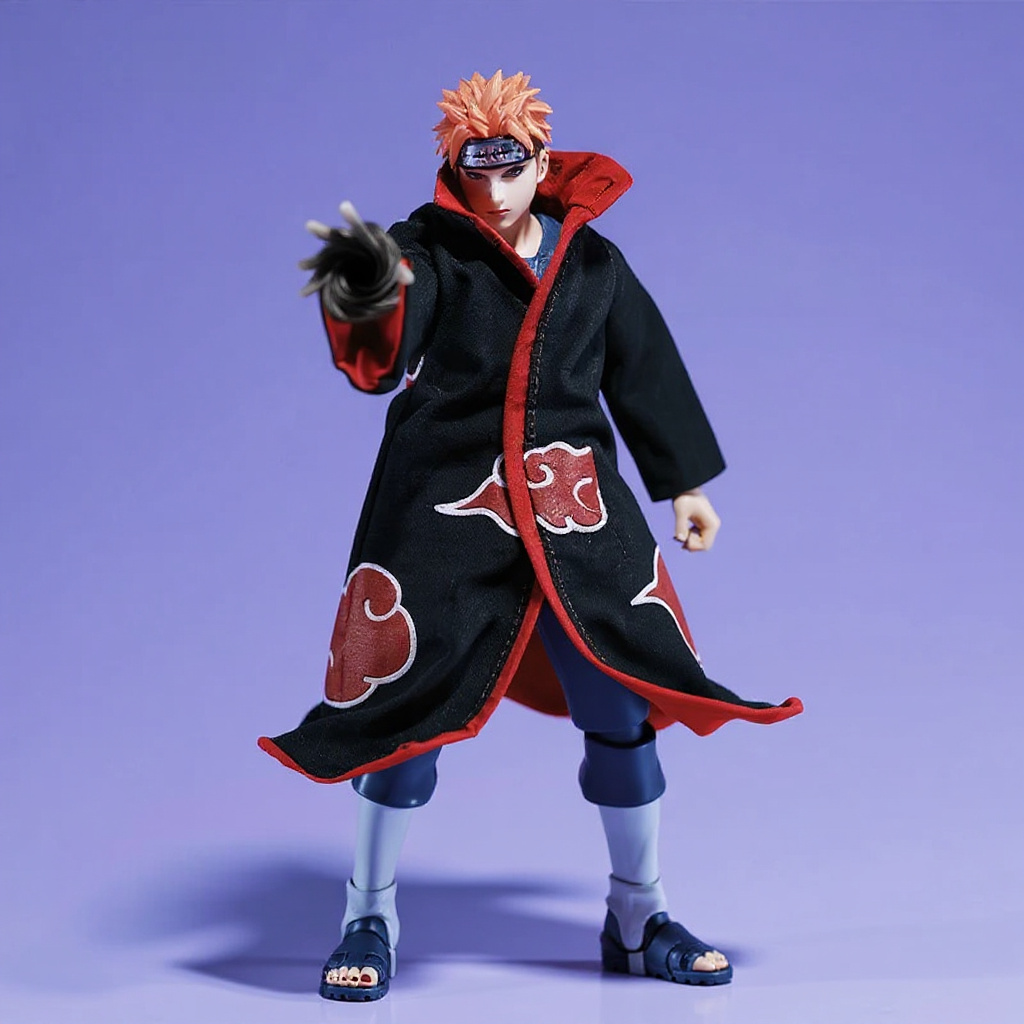
Our 1/12 Akatsuki Pain Cloak is cut to that collar height, built for this scale range specifically instead of scaled down from a bigger pattern.
Soft Goods vs. Plastic: The Real Difference
Plastic capes photograph like plastic capes. The material bounces light in flat sheets, creating hot spots that scream "toy" the second you zoom in. Fabric absorbs light closer to how real clothing does, which is the entire reason collectors pay more for it.
| Feature | Plastic Cape | Soft Goods Cloak |
|---|---|---|
| Price Range | $15-25 | $50-90 |
| Posability | Fixed shape only | Fully adjustable with wire |
| Photo Realism | Obvious toy look | Natural fabric drape |
| Durability | Won't tear | Can fray after heavy handling |
| Fit Options | One size fits most | Often tailored to scale |
| Attachment | Neck peg or clip | Multiple mounting options |
| Cleaning | Wipe down | Spot clean only, no machine wash |
Plastic wins on durability and price. That's it. Soft goods win on nearly everything else, especially in photos — Instagram dioramas and YouTube reviews both lean on that fabric drape to sell the shot.
Honestly, if you live somewhere humid and store figures in an unsealed case, the fabric can pick up a faint musty smell over a year or two. Nobody selling these will tell you that. Plastic doesn't have that problem. If climate control isn't happening in your display space, factor that in before you spend $53.
Wire Positioning: What Actually Works
Not all wired cloaks are built the same. Wire placement decides which poses you can hit and hold, not just whether the fabric moves.
Effective wire placement includes:
1. Hem edge wire — lets the bottom edge billow or sweep on command 2. Side seam reinforcement — stops the cloak from collapsing inward against the body 3. Shoulder area structure — holds the cape's shape when arms go up 4. Collar support wire — keeps the high collar standing instead of folding down 5. Strategic stress points — reinforced spots where fabric naturally pulls during posing
Cheap wired cloaks only wire the bottom hem. That buys you one dramatic swoosh pose. And nothing else. Quality construction wires multiple zones so the whole garment poses, not just the edge.
Wire gauge matters here too. Too thin and it won't hold a pose past an hour. Too thick and you see wire ridges through the fabric in photos. 22-gauge lands in the sweet spot for 1/12 scale accessories — I've tested 18-gauge on a mock-up and the outline showed up in every close-up shot.
Attachment Methods That Won't Damage Your Figure
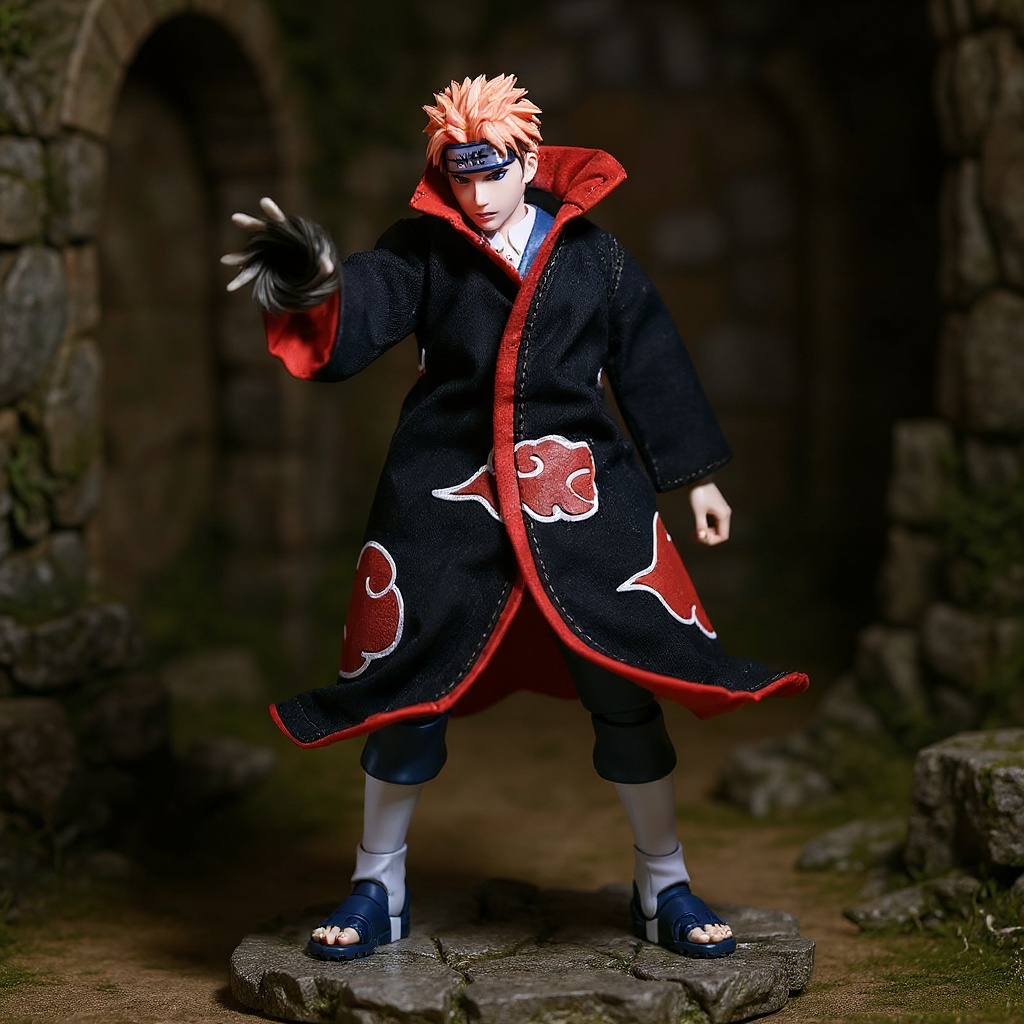
Most collectors worry about damaging figures when adding soft-goods accessories, and that worry is fair. Some attachment methods stress joints or leave permanent marks after repeated posing sessions.
Safe attachment options:
1. Neck collar system — slides over the head, no modification needed 2. Velcro back closure — wraps around without pulling on joints 3. Magnetic clasps — clean attachment and removal, doesn't wear out 4. Snap buttons — secure hold, easy to undo 5. Tie closures — adjustable tension, fully removable
Avoid cloaks that require popping off the figure's head or arms to install. That's unneeded stress on ball joints and neck pegs for a $40 body. A well-designed cloak slips on without disassembly. Full stop.
Some collectors add a tiny dab of poster putty at stress points to stop the cloak from shifting mid-pose. Remove it before long-term display, though — putty left in place for months can leave a residue ring on the fabric.
Color Accuracy and Pattern Matching
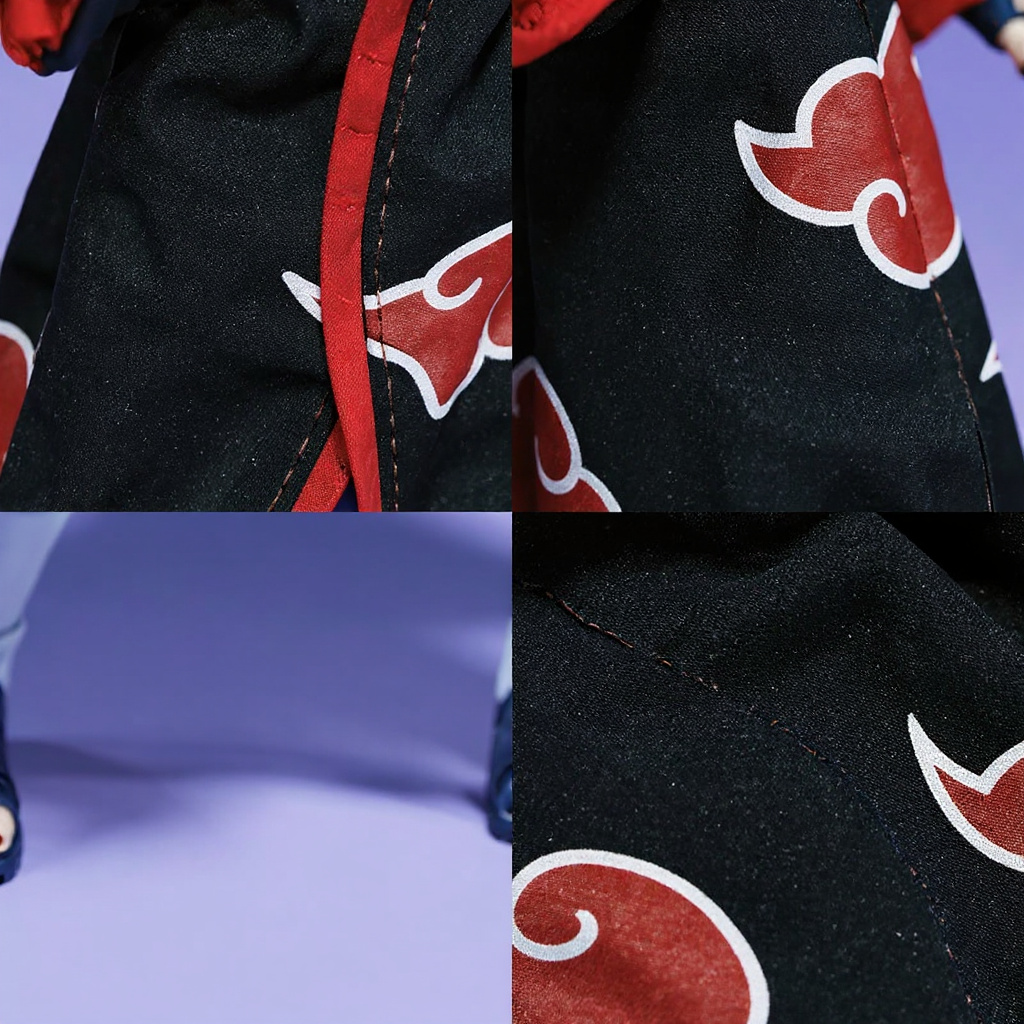
Pain's Akatsuki robe in the series) uses a deep matte black with dull red cloud shapes, not the glossy black-and-red combo you see on a lot of budget listings. Getting this right matters more than most buyers expect going in.Many bootleg versions use glossy red instead of matte, or a black that leans gray or blue under studio lights. Cloud size matters too — clouds scaled too large or too small break the illusion the second you photograph the figure next to anything else in frame.
Authentic Akatsuki robes feature:
- Deep matte black base fabric - Dark red cloud patterns (not bright red or burgundy) - Clouds sized to match the figure's scale, not a generic template - Interior lining in black or dark red - No visible brand logos or licensing text
Some sellers use bright red or orange clouds because it photographs "louder" in a thumbnail. To anyone who's watched the show, it reads as a knockoff on sight.
What Fits With What: Compatibility Guide
Not every 6-inch figure body works with every 1/12 cloak. Here's the breakdown, ranked from safest bet to riskiest:
1. Figma bodies (most releases) — standard compatibility, no adjustment needed 2. S.H.Figuarts standard builds — standard compatibility, collar sits correctly out of the box 3. Mafex human-proportion figures — standard compatibility, slightly wider shoulders but within tolerance 4. Most third-party 1/12 bodies — standard compatibility, check torso length before ordering 5. Figma with unusually broad shoulders — problematic, collar may sit high 6. S.H.Figuarts with bulky armor — problematic, cloak may not close over armor plates 7. Any figure over 6.5 inches or with permanent back accessories — problematic to incompatible, custom sizing recommended
If your figure falls outside the standard range, small adjustments help. Loosening tie closures adds about 0.2 inches of room. Tightening them takes up slack for smaller frames. For figures well outside standard proportions, you need a cloak cut to that body specifically — most handmade sellers can do this, but it adds lead time and cost.
Making the Investment Worth It
A $53 cloak for a $40 figure looks excessive on paper. Consider the use case first. If you're building a full Akatsuki lineup, one cheap plastic cape next to nine fabric cloaks breaks the visual coherence of the whole shelf.
For photography, the fabric pays for itself in image quality. I switched three figures in my own lineup from plastic to fabric last year, and the difference showed up immediately in flash photography — the plastic ones looked like they were lit with a flashlight, the fabric ones didn't.
Durability cuts both ways. Fabric can fray or stain. Plastic can crack or lose paint at the fold lines. Handled with normal care, a quality fabric cloak held up through two years of weekly repositioning on my own Pain figure, edges intact.
Handmade construction means some imperfections show up — a slightly uneven stitch line here, a minor color shift between fabric batches there. That's the tradeoff for not being mass-stamped from the same mold. Mass-produced perfection often looks sterile sitting next to a hand-sewn piece anyway.
Frequently Asked Questions
Is there anywhere I could buy a cloak that looks like this? Handmade Akatsuki cloaks are available from specialty figure accessory makers. Quality varies a lot between sellers, so check construction photos and ask about wire placement before ordering — a listing photo alone won't show you where the wire actually sits. Why did Taka/Hebi's Akatsuki coats have hoods? Taka (formerly Hebi) wore modified Akatsuki robes with hoods to mark their status as affiliated outsiders rather than full members. The hood was a visual shorthand the show used to separate them from the core roster without redesigning the whole silhouette. Is Konan the only Akatsuki member to die with the robe on? No. Konan died in her Akatsuki robe, but so did Itachi, Nagato, and several other members depending on the arc — this claim shows up online but doesn't hold up against the source material. Why did some Akatsuki members revived as Edo Tensei wear coats and others didn't? Edo Tensei brings characters back in the clothing tied to their last confirmed appearance or most iconic look. That's why the rule produces inconsistent results across characters — it depends on when in the timeline they died, not a fixed costume rule. What figure sizes fit a 1/12 scale Akatsuki cloak? 1/12 scale cloaks fit figures between 5.8 and 6.3 inches tall with standard human proportions. Oversized or heavily armored figures often don't close properly at the front. Can a fabric cloak actually hold an action pose like plastic can? Wire-reinforced fabric holds poses better than plastic in most cases I've tested, since the wire bends into any shape and stays there. Plastic only bends at the seams it was molded with. How do you attach a soft-goods cape to a 6-inch action figure? Most soft-goods capes use a collar system that slides over the head, or a back closure with velcro, snaps, or ties — none of which require popping the figure apart. Is a handmade Akatsuki cloak worth more than a cheaper Amazon or eBay version? Handmade cloaks generally use better fabric, wire in more zones, and closer color matching, but they cost 2-3x more than mass-produced alternatives. Whether that's worth it depends on whether the figure is going in photos or just sitting on a shelf. Does a 1/12 Akatsuki cloak fit a Nendoroid? No. Nendoroids run smaller than 1/12 scale, and a cloak built for a 6-inch body will swallow a Nendoroid's proportions. Don't buy a 1/12 cloak for a chibi-scale figure — check the product listing's scale number before ordering, not just the inch measurement. Can you wash a fabric Akatsuki cloak? Spot clean only. A full wash can loosen the internal wire or warp the shape, so skip the washing machine entirely and use a damp cloth on stains instead.Does the Extra Cost Actually Matter?
For casual collectors who pose a figure once a month, a $20 plastic cape probably does the job. For photography or display-quality builds, the fabric shows up in every close-up shot the plastic can't fake.
Wire positioning alone justifies the price gap for a lot of collectors. Shaping the whole cloak instead of bending it at one molded point opens up poses a plastic cape simply can't reach.
Handmade quality also means the money goes to someone sewing individual pieces, not a factory line. That matters to some collectors and means nothing to others — know which one you are before you spend the $53.
If you're building a serious Naruto collection or need screen-accurate accessories for photography, our 1/12 Akatsuki Pain Cloak delivers wire-posable fabric realism that plastic can't match.

